
A Love Letter to the Mary Jane
A Love Letter to the Mary Jane

Written by Sofia Welch
Photographed by Ema Sabau
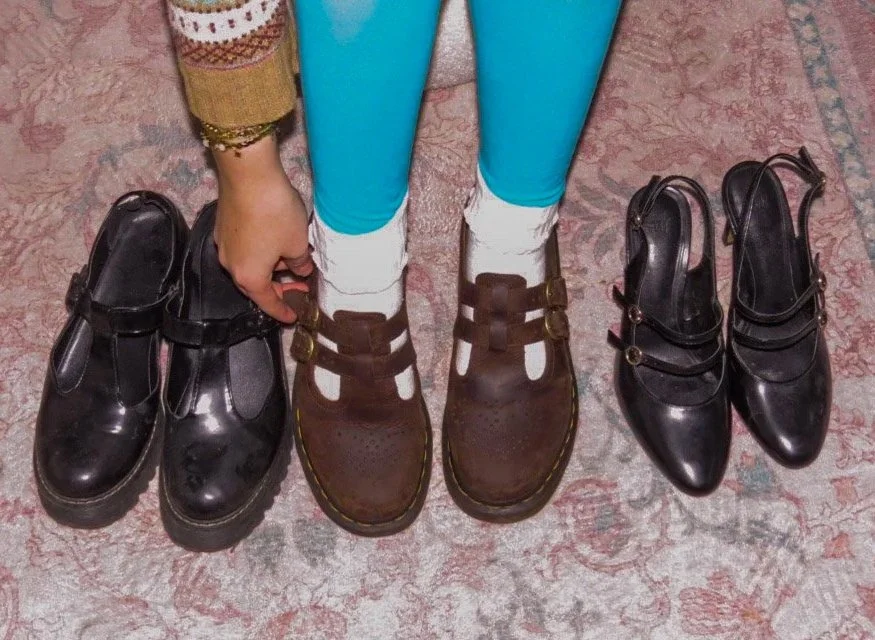
A brown leather pair of Doc Martens that I received this past Christmas, which I’m still breaking in. A classic black patent pair with a heel that I wore to every formal in high school. A stiletto pair with double straps and mini gold buckles that hurt my feet. My current, still-growing, collection of beloved Mary Janes. Something in me has always gravitated towards its simple, sweet silhouette: closed-toe, low-cut, with a strap across the instep. This iconic style has taken over my modern shoe rack, leaving little room for anything else.
Mary Janes first stepped into the cultural spotlight in the early 20th century when the Brown Shoe Company associated the early style of the shoe with the character of Mary Jane from the Buster Brown comic strip. The simplicity and durability of the shoe made it popular for young girls and boys. However, in the 1930s, a more grown-up version was appropriated by the flapper aesthetic. It was a comfortable choice for high-energy dancing, and the innocent connotation of the shoe contrasted with the freedom and empowerment at the heart of the flapper girl lifestyle.

Among the evolving cultural landscape of the 1960s, the Mary Jane saw a shift from a practical piece of footwear to a bold fashion statement, showing women’s desire for expression and independence, as fashion historian Emma Katharina observed. The youth culture and Mod fashion movement in the 60s was a rebellion against traditional conservative styles, led by young people who wanted to express themselves through clothing. The Mod style popularized chunky, bold Mary Janes, with platform heels paired with mini skirts and shift dresses. A move toward shorter hemlines in young women’s fashion was emblematic of women’s desire for less conservative clothing. Shorter ensembles made shoes a focal point. New, cheaper materials like vinyl meant that shoes were treated as accessories rather than necessities, experimenting with brighter, trendy colors and bold two-tone combinations. Popularized by figures like Twiggy, with her iconic babydoll lashes, Mary Janes captured the hearts of “Dolly Girls,” lovers of an aesthetic that Katharina described as “a subgenre of Mod style that channeled playfulness and femininity.”
Mary Janes continued to be a large part of fashion and returned to mainstream culture in the 1990s. Underground London’s subculture blog explained the grunge-era dichotomy Mary Janes represented, noting how figures like Courtney Love channeled the feminine grunge aesthetic by juxtaposing the sweet femininity of Mary Janes and florals with the angst of dark makeup and undone hair. The runway also frequently featured Mary Janes in the collections of popular 1990s designers like Chanel, Betsey Johnson, and Marc Jacobs. Designers and pop culture today still favor the Mary Jane. Marc Jacobs’ popular “Kiki Knee-High Boot” is basically a Mary Jane on steroids with its towering heel and eleven buckle straps. 2020s online fashion trends also adore the Mary Jane; its versatility and vintage associations make it popular among young girls who seek to channel a more distinctive, timeless style amid microtrends.
My love affair with Mary Janes started with one pair and escalated quickly from there on. The Mary Jane style of shoe was something I wore as a young girl, and part of my attraction to it is the nostalgia and vision of my younger self it evokes. With growing pains and an unsure sense of self, channeling this style in my footwear was something comforting. The versatility of the style allows me to experiment with my fashion, while still having the throughline of the Mary Jane to anchor me. It’s a way to embrace my femininity and love for fashion. It’s become an irreplaceable part of my style and identity. Though simple and juvenile in origin, I carry their cultural transformation and the lives of all the women who have worn them throughout the last century with me every time I buckle them on. They have become symbols of a woman’s expression, boldness, and freedom.
Mary Janes were never just one thing. They are timeless yet ever-changing, innocent yet powerful, nostalgic yet fresh. The Mary Jane never limits itself, and with it at the heart of my style, it reminds me never to limit myself.