
When Harry Met Kombucha
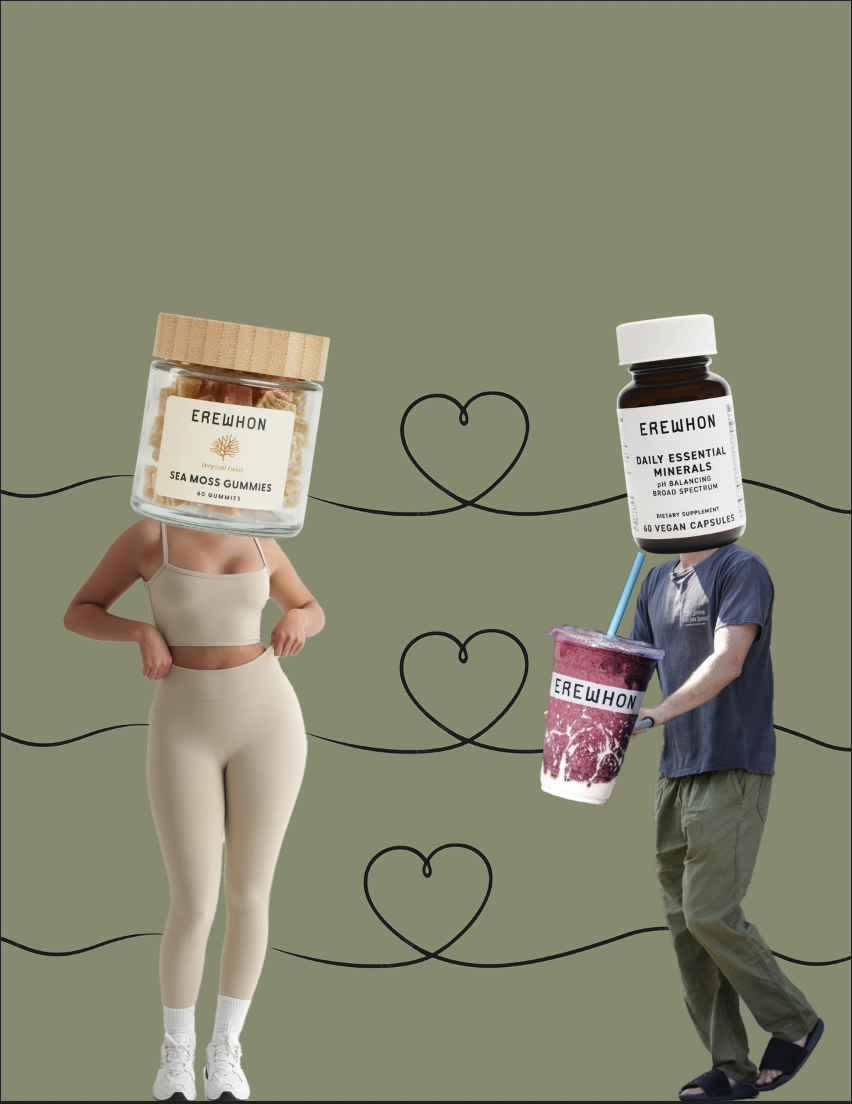
WHEN HARRY MET KOMBUCHA
WRITTEN BY KAT BOSKOVIC
PHOTOGRAPHED BY ART BY IZZIE CLAUDIO
Modern romance has a new aisle: it’s not Tinder, the window table of a coffee shop, or trivia night at your local bar three margaritas in, but an upscale grocery store where, alongside $34 sea moss gummies, love is now something you can shop for! Erewhon, Los Angeles’ gleaming temple of wellness, has become the poster child of this shift, a place where asking, “How’s the soup?” doubles as a courtship formality. The appeal is obvious: meet someone who already lives the lifestyle, spends the money, and speaks the language of probiotics and hyperproductivity. But beneath the illusion of organic flirtation between the non-GMO limes and avocados, is something far more curated—a dating economy where compatibility is prefiltered by purchasing power.
Erewhon markets itself as the antithesis of the dating app. It’s the place you go when you’ve just about had it with the creeps in your Hinge DMs and want to let fate take the reins. When 70 percent of Americans report having tried online dating at some point in their adulthood (Pew Research Center), and roughly half of these users feel negatively towards these apps (The New York Times), it’s no surprise that we’ve gone back to the basics. Now, there are TikToks instructing singles on how to loiter near the tonic bar, how to hover by the hot bar without looking desperate, and how to hold a wellness shot like a prop of intrigue. The flirtation script is so widely circulated it’s practically ritual: “How’s the soup? It’s hot.” Two lines, delivered among eucalyptus steam and kimchi jars, meant to signal spontaneity. A meet-cute with a receipt.
Except nothing in Erewhon is spontaneous. The romance only feels organic because everything else has already been curated for you: the lighting is soft, the carts are minimalist, and the produce is impossibly misted. The other shoppers are uniformly luminous, Pilates sculpted, and holding something containing cordyceps. It is a closed ecosystem where unpredictability has been airbrushed out. You are not encountering strangers, but rather brand-aligned mirrors.
The irony? Erewhon sells itself as “real life” while functioning like an application. The aisles might be physical, but they are no less filtered. The premium subscription is your $200 membership, the profile photo is your $300 athleisure set, and your bio is implicit: I juice. I journal. I do not microwave. It is a romance available in three flavors—Sofia Richie’s Sweet Cherry, Hailey Bieber’s Strawberry Glaze, and Bella Hadid’s Kinsicle—and none of them are a mystery.
When you order these drinks at the smoothie bar with your monthly complementary discount with your $200 membership—on top of the $50 jar of chicken noodle soup in your cart—you’re not just ordering a drink but signaling an ideology. A potential partner doesn’t ask what you like when they can easily glance at your smoothie and know everything, from your podcast queue to your supplements to even how often (or little) you go to the bathroom if you’re sporting Kourtney Kardashian’s Poosh Potion Detox, rich with activated charcoal to help you go.
In this ecosystem, the ideal relationship becomes a co-branding opportunity. Two individuals who share gut health protocols, infrared sauna memberships, and a mutual distrust of seed oils finally find each other in a tragic dating pool of gluten consumers. Love is marketed as optimization, because what should a partner be if not proof that you track your macros? Compatibility is prepackaged and all you must do is select someone with parallel presets. The goal is not intimacy, but synergy.
Yet, this promise of “organic IRL connection” comes with an unspoken terms of service: only certain bodies, budgets, and zip codes may apply. In the exclusive neighborhoods of Beverly Hills, Calabasas, Pasadena, and the Pacific Palisades, behind guarded entrances and between manicured palm rows, weathered romance tropes like “we met at the grocery store” become a gentrified myth. Just under 10 miles south of Pasadena’s Erewhon in Lincoln Heights, one of the first neighborhoods for immigrants of Los Angeles, that glossy ideal collapses; the nearest “meet-cute” aisle isn’t a curated Erewhon produce section but a corner store in a food desert.
Only the wealthy and the white can subscribe to this new dating approach. The $21 jar of pesto, the $26 bag of trail mix, and the $30 pack of ice cubes are less products than velvet ropes. To linger in these aisles, you need time, disposable income, and the confidence that you belong in your matching ALO set. Leisure becomes a mating display and so does literacy in wellness language—ashwagandha, biodynamic, adaptogenic. Class is not hidden, but aestheticized.
So when cult shoppers say they’re ditching the apps to meet someone in real life, what they often mean is: I want a partner prefiltered by privilege. The fantasy of spontaneity, yes. But only with those who can afford to purchase spontaneity in recyclable glass.
Contrast this with the places where romance once unfolded: the corner bodega, the messy bar, the public park, even the uninspired fluorescent lights of a regular grocery chain. In Spain’s Mercadona, there’s a running joke that flirting happens across carts full of pineapples, a tip that the shopper is looking for love. These encounters are awkward, unscripted, and embarrassing, but that is precisely why they feel human. They require vulnerability, not performance. At Erewhon, nothing can go wrong. And so, nothing can truly begin.