
My Work Wife is Ruining My Life
My Work Wife is ruining my life
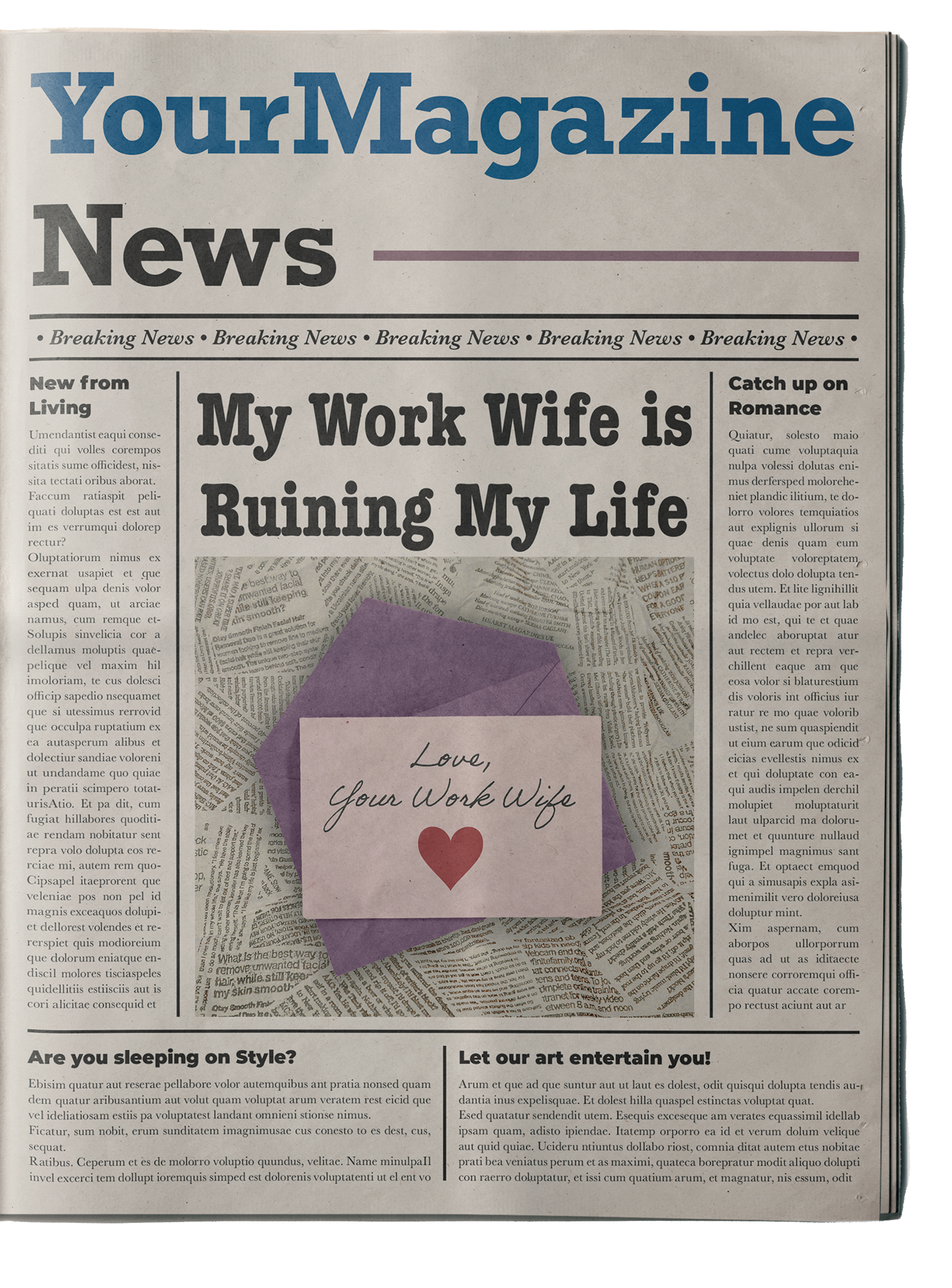
Written by Meg richards
Art By Lauren Mallett
My work wife is the biggest bitch I know. Let me tell you why.
For starters, I can barely focus on my studies. Just knowing she’s watching and waiting for me to give her attention tears away all concentration. She’s so demanding of my time. Hours a day, easily over a dozen hours a week, just spending time together. And when we’re not together, I’m thinking about her—as if I don’t give her enough time to begin with! It’s not the fun kind of thinking, either. No smiling to myself and daydreaming, no. It’s grinding my teeth in class, laying awake at night, and waking up with scratch marks on my chest from night terrors. She’s the first thing I think about in the morning and the last thing I think about before I go to sleep. It’s an existential feeling of dread that the story is far from over. It gnaws away at me, but I can’t divorce myself from her.
Because she’s not a real person.
No, my work wife is not a human woman at all, but the looming presence of what I consider “my work.” As a budding writer and student leader of a school news organization whose lifeblood is writing it feels like every piece of work I now produce will dictate how successful the rest of my life will be. Every decision is more consequential than the last. Each passing day the deadline of my young adulthood creeps closer and closer. It started when I first stepped foot on Emerson College’s campus, when I wrote my first article for the school newspaper, the first time I applied to be an editor, and now, with every piece of writing I produce. I toil over each adjective, noun, adverb, oversharing-anecdote and over-used adage, imagining future employers reading my words and deciding whether or not to give me the kind of job I want after graduating: something that pays well, impresses people on LinkedIn, and fulfills my career aspirations—and also something I can wrap up with a bow at the end of the day and put away until the next morning. A job I can separate myself from enough to feel like when I leave work, I actually leave work. No carrying it around in my pocket, no seeing it in passing and desperately trying to avert eye contact with it, and certainly not losing any sleep over it.
But here’s where the central conflict is: my work is not just a ball-and-chain partner whose nags I can’t get out of my head. When I write, I open myself up (literally, in an open heart surgery kind of way) and let my blood pour out onto the page (or MacBook Pro, in this case). My words are my DNA; my work is my child. It’s a child who evolves with each iteration of my blog, Substack, Notes app, or the school newspaper. Anywhere I can slap my DNA and leave my mark, I’ll do it. It’s my futile attempt to fly towards the sun. With each sling of my words and hurl of my paragraphs, I convince myself that I’m that much closer to my dream job. I just hope my wings don’t melt off before I get there.
And what would that look like? Simply put, burnout. Except “burnout” is not a strong enough phrase to describe the feeling, nor the reason I’ve never burned out the way I burned out this year. Juggling being a student with being a journalist, a student leader, and a writer, I’m no longer just burning the candle at both ends; I’ve opened up a new dimension of candle ends using quantum reasoning to burn ends of candles never previously comprehended by the human mind.
The thing is, I’m not alone. This is simply the college experience, right? It’s the 21st century; we are coming of age at a time where the internet is the most advanced it’s ever been, and capitalism the most unregulated. This is hustle culture, baby.
For workaholics, starving artists, tortured poets, or misunderstood geniuses (with those categories, I’ve named every type of Emerson College student), your work never leaves you. When I close my eyes at night, my words flood my mind, dancing behind my eyelids, taunting me with the far-away prospect of sleep.
I imagine The Birth of Venus tormenting Sandro Botticelli in this same way: a mirage of roses, myrtle swimming among golden locks of hair, begging him to rip his eyemask off, pop his retainer out, and start vomiting that shit onto paper. I wonder if his vision of success was impaired by ingesting the same cocktail of imposter syndrome and burnout as the rest of us. It provides some solace to know that Botticelli was nearly 40 when he painted Aphrodite, meaning the rest of us still have time. In fact, with those numbers, most of us are only half the age we’ll be when we paint our own Births of Venuses. But Botticelli was not inundated with LinkedIn updates and “pov: you got your dream job at 21” TikToks to inhibit his motivation every time he opened his phone, as if to say, “You may feel good about where you’re at, but look at where everyone is. That could be you!”
However, it provides some consolation that—though he was one of the great artists of the Renaissance—Botticelli also struggled as much as the rest of us striving for greatness. He pissed away his money and never married. His longest, most withstanding love, like so many of us, was his work. His greatness was eclipsed by the likes of Michelangelo and da Vinci after he died. But he also has an asteroid named after him. So, maybe we can be comforted by the thought of the artists who precede us sacrificing for their art, only to be compared to their peers (even in death) and have their Venuses overshadowed by a Sistine Chapel.