
The Revolution Will Not Be Merkinized
The revolution will not be merkinized
Written by Kat Boskovic
Art by Hello Giaever
In the sweltering months of summer 2024, between leopard print and Love Island USA watch parties, BRAT remixes and the possibility of a first woman president dangling before us with a beckoning wink, it felt like we were on the brink of something fantastical. With the momentum of Barbie and the reclamation of girlhood and everything pink from the summer before, the honeyed air of June, July, and August carried tantalizing promise…with a sprinkle of pubic hair.
The bush was back, baby—and no, not George W. Bush (thank God). In a long-awaited bush renaissance, there were bushes at the beach, bushes in low-rise jeans, even bushes on main. The bush became a badge of coolness to even be judged by @president_bush_1, a self-proclaimed bush psychic who conducted bush aura readings on celebrities: Hailey Bieber is allegedly as bald as a mole rat, but Selena Gomez has a bush that bewitches every man she has ever dated—hence why Justin Bieber called her twenty-three times on his wedding day. Bush.
And then, like how many good things come to an end, Kim Kardashian came to ruin it all.
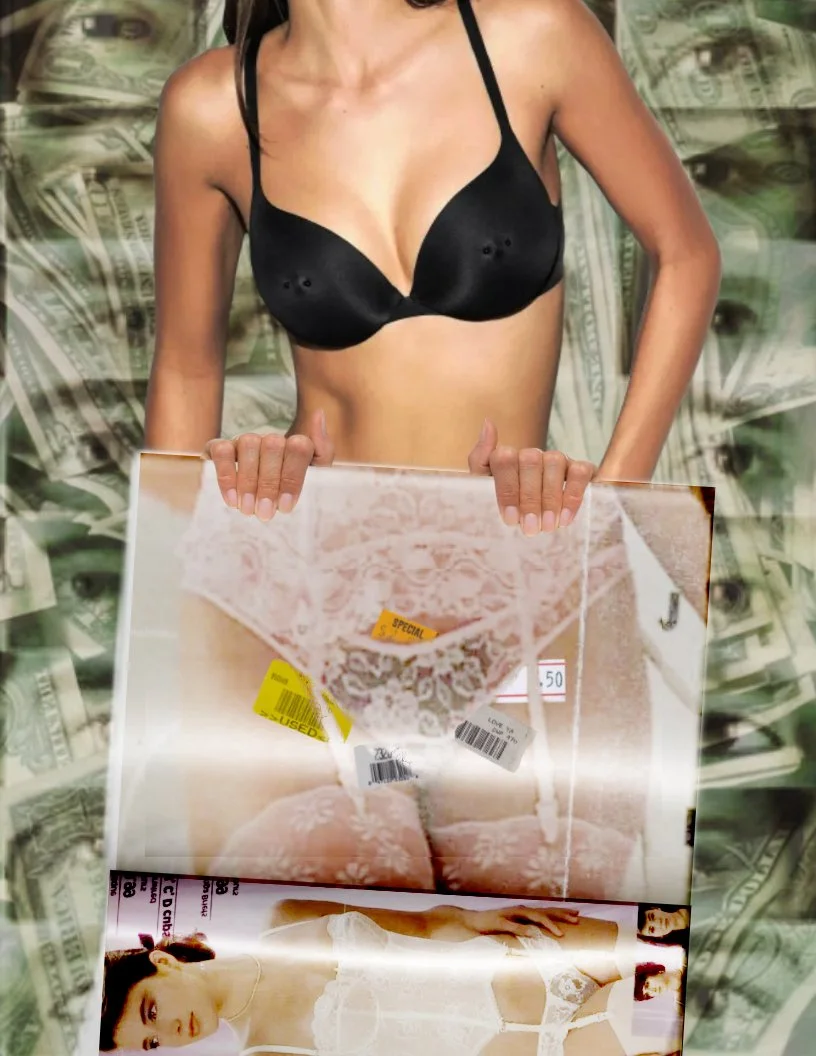
As if commodifying the nipple wasn’t enough, we’ve now lost the bush to SKIMS too. With six different color varieties and a myriad of hair textures, you can now purchase your own bush for only thirty-two dollars. “Why we love it?” the SKIMS website prompts. “With this iconic new panty, your carpet can be whatever color you want it to be.”
Sure, I could perhaps get behind a line of neon bush panties offered in Psychedelic Pink or Eclectic Emerald or Blitzing Blue to spare vulvas from the dangers of bleach in pursuit of a bioluminescent bush, but these bush panties are only offered in natural shades of blonde, ginger, brunette, and black. So, you can put your bush on in the morning and take it off at the end of the day like any other accessory, and that’s what it can remain as: an accessory. But in its potential as an accessory therein lies its fault too, for no bush-owner would wear this to conceal their own bush.
In fact, the very idea of layering an artificial tuft over a living one feels like an uncanny form of self-erasure, as if the real thing—with its texture and unruliness and heat and politics—must be hidden beneath a tidier, brand-approved simulacrum. This is not the ecstatic, sun-warmed, slightly feral fringe that anchored the bush renaissance of summer 2024. This is a corporate bush. A managerial bush. The SKIMS bush isn’t meant for people who already have a bush; it’s meant for people who want the implication of one without the lived political reality.
What SKIMS fails to realize is that the bush has never just been hair. Consider Algeria in the mid-20th century, during the fight for independence. French colonial officers treated pubic hair as evidence: a woman with a bush suggested her husband was still away in the rebellion, whereas a woman suddenly bare announced that he had come home. Hair or no hair became a code of war, surveillance and resistance performed beneath skirts and behind closed doors. Pubic hair was not fashion; it was a battleground.
At the same time, four thousand miles away, the free love movement in the United States took off and the bush slipped into an entirely different register. It was a pubic manifesto that grew alongside civil rights protests, anti-war marches, second-wave feminism, and a widening refusal to be tidied up for the patriarchy’s viewing pleasure. The bush belonged to the body, and the body belonged to the woman—not the market.
In 2024, with 14,000 women telling The Review of Beauty Substack newsletter that nearly 30% keep a full bush (and only 15% go totally bare), a bush resurrection was in full bloom. Sure, Belgian-founded Parisian fashion house Maison Margiela’s haute couture collection that year paraded merkins under sheer skirts galore, and creative director John Galliano had explained to System magazine that his greatest inspiration was the artist Brassaï’s photography of Parisian sex workers—the commodification of poverty on the fashion runway, which is nothing new. But with price marks in the thousands, the common masses couldn’t access this commercialized bush anyway—not until Kim Kardashian brought down her trough of slop for us to gobble up for $32 apiece (gobbled up, unfortunately, in 24 hours, because every shade and texture is now out of stock). But these panties fail as functioning undergarments as well; 82% of their material content is polyamide, a polymer notorious for its poor breathability and its tendency to hold moisture and odors.
And if smelly panties aren’t enough, smelly, polluting panties sure are because polyamide is manufactured by a petroleum-based production cycle. Congratulations: now your artificial bush you could have grown yourself–for free–contributes to greenhouse gas emissions!
And that’s the most dystopic part: not the fake pubes themselves, but the logic beneath them. We’ve arrived at a point in late-stage capitalism where the body’s natural functions are no longer simply discouraged or pathologized; they’re repackaged, rebranded, and resold to us at a markup. First, women were convinced to strip themselves bare, and agonize over the multitude of methods to do so. Then, once the beauty industry wrung every possible dollar out of hairlessness, they turned around and sold us the antidote. Here, just for $32, is the very thing your body is already capable of producing with time, hormones, and a little patience.
The Kardashian empire, with its uncanny talent for sniffing out marketable insecurities like a pig sniffs truffles, espied our bush renaissance and sunk its claws into it immediately: “[Women] are feeling nostalgic and want something from a different era,” Kim Kardashian said on Sirius XM. One month after the launch, as we’re spending two hours of a generous state’s minimum wage on a petroleum-based imitation of something our bodies already grow naturally, the Kardashians are celebrating their mastermind Kris Jenner’s 70th birthday where she can flaunt her new face to an elite guest list that includes the third and fourth richest men in the country, Mark Zuckerberg and Jeff Bezos. The contrast feels almost satirical: the matriarch of the most famous family in America floating across a marble floor in vintage Givenchy while her daughter sells us crotch toupees.
It’s a performative bush for the algorithmic age: a tuft flattened into content, pre-approved for mass consumption, palatable enough to earn a Vogue headline about “the return of the bush” without alarming a single ad partner. And all of this lands with even more bite when you remember where SKIMS is expanding next, new stores that—oddly enough—have barely even been mentioned in the media: Israel. It’s hard not to notice the uncomfortable echo of a corporation profiting from controlled simulation of freedom while planting its flag in a settler colonial ethno-state where actual human freedom is stripped from Palestinians indigenous to the land. A bush with borders, indeed.
The SKIMS bush is a bush declawed of its historical roots in protest, sexual autonomy, class resistance, queer identity, and feminist refusal. It is the opposite of the Sixties bush, which grew like a soft, defiant banner of the self; the opposite of the Algerian bush, which carried intelligence on its very surface; the opposite of the 2024 full-bush bikini revival, which announced the exhaustion of capitalist management.
So maybe the only real response, one we’ve learned from our rebellious sisters, is to refuse the prefab versions entirely. Let the bush be unruly, uncurated, unsponsored. Let it grow past the borders of what is acceptable in campaign photography. SKIMS has shown us that anything can be packaged, trimmed, and resold as empowerment if we’re not paying attention, so the only worthy liberation is the one we grow ourselves.
In other words: this time, we must seize the means of the bush.