
I Perfect, Therefore I am
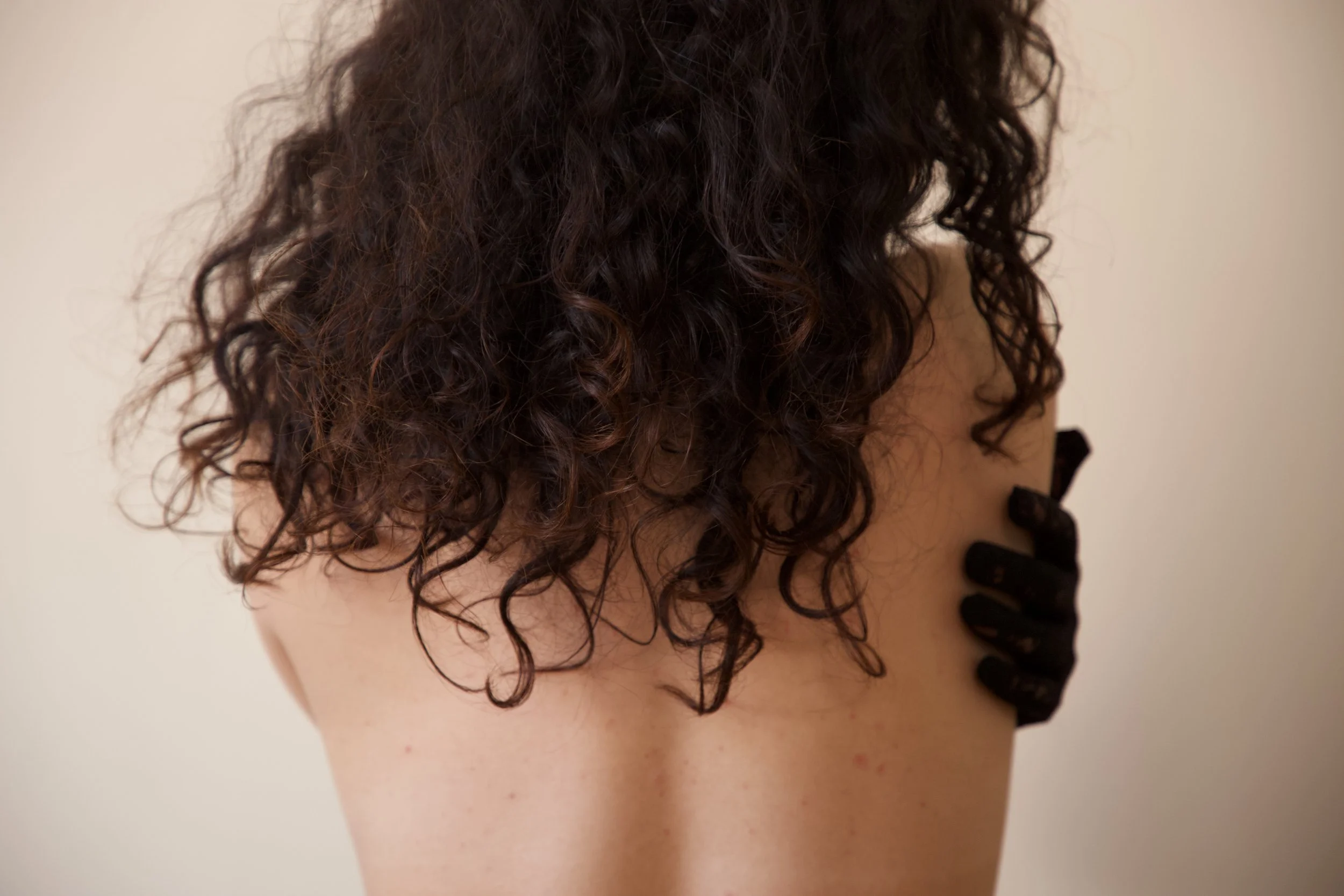
I Perfect, Therefore I Am
Written by Molly Peay
Photographed by Mia Cassidy

My body is an hourglass. My color palette: soft summer. I look best in light blues, butter yellows, and baby pinks. Feminine clothes look best. Do not wear anything baggy. Work out 3 to 5 times a week. Never less. Make sure you work your arms so “the girls” are perky. Work your butt so you are never called “flat.” Work your abs so you can never look “bloated.” Eat well. Manage your carb-to-protein-to-vegetable ratio. Braid your hair at night. Or, curl it in the morning. Wear eyeliner, mascara, lip liner, lip gloss, tinted sunblock, and eye shadow, achieving the best no-makeup makeup. On occasion a red lip. But never too dark. Remember you are a soft summer. Pink looks best.
But there is a line, is there not? At what point does styling our body to “look our best” and “feel our best,” bump into over-working, over-exhausting, criticizing, and breaking down, even in menial ways? My best friend complains about my attempts to avoid certain colors because a color analysis told me black and brown are not my friends. Yet, I’ve seen this same tendency in others: obsessing over their bodies and refining their appearances; often not for themselves, but for the world.
In high school I was on the dance team. Dancers have the connotation of being fit. Skinny. Flat stomachs. Lean thighs. My teammates would compare notes to conform to this image, sitting in the back seat of the car asking, “What is the best way to throw up?”
“Oh, in the shower so nobody will hear you,” was the response.
The naturality of glorifying bodily abuse to feel beautiful or skinny, to better yet be called beautiful and skinny, has infiltrated right down to our internal dialogue. It goes beyond simple beauty standards: it is easy to romanticize overworking our bodies in the pursuit of perfection.
None of us would like to admit that we would rather hound for the unattainable than confront the anxiety-inducing thought that we can actually be at peace if we accept ourselves where we are. This hyperindividualism distracts us, convincing us that there is value in self-optimization.
As Harvard Business Review puts it in their article “Why We Glorify Overwork and Refuse to Rest” by Tony Schwartz and Eric Severson, “We often experience a greater sense of our own value when we’re working than we do when we’re not.” We work to extract value from ourselves, treating our bodies as projects—in exercise, diet, beauty, and fashion. These facets become sites of optimization, a productivity metric that we disguise as our “personal style.” Except this is only a misguided label for the restlessness that drives us to overwork—the logic of capitalism itself! We must improve, refine, and continuously become: we exercise till exhaustion. We exercise when exhausted. We exercise when we are sick; many times I have witnessed people coughing and sputtering all over the Emerson gym floors. The choice to exercise extends beyond the bounds of movement, to a controlled performance or compensating for the food we eat; even self-care becomes an act of production.
Instead of eating intuitively, we cut out carbs, even when our body screams CARBS! CARBS! CARBS! “Oh it will help my acne,” my friend told me. “Oh it will help me feel better about my body,” another said. Each confesses their dissatisfaction with their appearance. Still, while attempting to reconcile bodily dissatisfaction, preoccupying ourselves with the unattainable, we ignore the nutrition truth of carbohydrates. Keto—removing these vital nutrients entirely from our diet—was created for epilepsy, but the diet industry saw this as an opportunity. It sunk its teeth into it. Now, we are being sold Keto Diet plans from Forbes Health among so many other companies. By this misguided promotion, it is hard to discern that carbs are our bodies main source of fuel. They are essential for creativity, good sleep, and producing great work!
It’s normal to want to feel good and look good for ourselves. However, the “for ourselves” and “for others” part is typically conflated. Our bodies do not think about the slope of our stomach or the curvatures of our thighs. Our brain, though, is highly sensitive to the level of social acceptance our appearance brings; no wonder we easily fall prey to trends when it gives us the illusion of belonging. And for those who can afford more permanent solutions to diet and skincare fads: surgery, botox, laser.
Take Kris Jenner; seventy years of age on November 5th, Jenner has paid for a significant face lift. Many social media accounts have likened her “new” appearance to her daughter, Kim Kardashian, forty-four years of age. One face lift reduced almost thirty years (in appearance alone).
We’ve built an economy around denying age. Every serum, filler, and filter is a small payment toward a semblance of timelessness—a semblance governed by an outdated, uninclusive, overly white, and overly infantilized or masculinized beauty system. The trends and fads we follow fill in the gaps of what we can’t afford. Still, neither option serves our bodies or our relationships to them.
The Fashion Times article, “How inclusive is the fashion industry and how does it impact capitalism today?” by Loanne Secula, states that fashion access is limited to the part of the population that can afford the societal standard of beauty. Even with the push for inclusivity and the significantly lower priced dupes of top runway looks, fashion is run by class driven hierarchies which continue to dictate this beauty standard.
Moreover, plus-sized runaway content has plummeted since the Spring/Summer 2020 season. This normalization of openly exclusionary content is symptomatic of our country’s current shift toward conservatism. Right-wing values systematically oppose anything that deviates from the traditional binary. The party’s fashion, beauty, and aesthetics, is a tell-tale sign; on Inauguration Day, Donald Trump emerged alongside ‘uniform’ women. They stood in high heels with “bouncy blonde blowouts, overdone makeup, and ultra-traditional skirt suits,” Madeleine Schultz wrote in Vogue Business’s article “How the Conservative Era will Change Beauty Standards.”
For upper-class conservative women, right-wing fashion can approximate variations of ‘corporate feminine couture.’ Corporate America pushes women to have a clean appearance: straight hair, youthful skin and hair, waxed facial hair, white teeth, and a lean body. Rohina Katoch Sehra nods to in a HuffPost Life article. “Right wing style is largely defined by perfectionistic, heavily aestheticized elements: over-symmetry, over- harmony, edge avoidance. In the top ranks, the result is bland, frisson-free dressing.”
Although appearing to differ from upper-class conservative women, constituents often dress with ultra-traditional domesticity and motherhood in mind. These aesthetic shifts have taken over social media, the “tradwife” a prime example. We see Hannah Neeleman making food from scratch in prairie dresses after abandoning her passion for dance to embrace the domestic life of raising eight kids on her farm, Ballerina Farm. In the same HuffPost Life article, UC Berkeley Gender & Women’s Studies professor Minoo Moallem explains that they feel the use of these commodities reinforce gender binaries that reflect a future aligned with the ‘good old days,’ a time where Republicans believe patriotism, traditional family structures, and faith were widely upheld.
Simultaneously, as conservative politics flood our government, people have begun sharing exclusionary views. Dazed’s article, “The Beauty Backslide,” explains that conservative outlets frame “the once-celebrated body positivity movement as ‘emotionally manipulative,’ accusing them of gaslighting the public into accepting unhealthy lifestyles.” So, instead of body positivity, we see #SkinnyTok, heroin chic, and Ozempic chic videos—the “SkinnyTok” hashtag reaching 2.4 billion views.

These aesthetics keep us occupied, focused on self-surveillance rather than community-building—our individual choice clearly an illusion when we are so influenced by capitalist market choices and structures of inequality. The Center for American Women and Politics states that “self-objectification is negatively correlated with political efficacy, interest, and information-seeking.” By trying to conform to beauty standards, we objectify ourselves, treating our bodies primarily as an object to be evaluated by others. And, if we are so fixated on our own flaws, we have far less capacity to organize.
So, while our bodies are our temple to decorate and adorn and adore, to dress in the colors we like, we must know the line. Once styling ourselves breaches the sanctum, and becomes a preoccupation with should or should not—following fads that do not suit your inner self, but that of an unattainable classist beauty ideal—we have found the line. That line separates us from community and truth. It separates us from the sociopolitical values we performatively post online instead of organizing in meaningful ways that create change. Remember, capitalistic and oppressive regimes thrive when we are so focused on our own dissatisfaction that we do little to question the systems that keep us oppressed.
So, I ask: have you de-capitalized your relationship with your body? Or do you still care for it only as a means to conform to a standard of beauty, and abuse it when it does not comply?