
Tehya Is Tired of… Half Baked Reimagines
Written by Tehya Tenasco
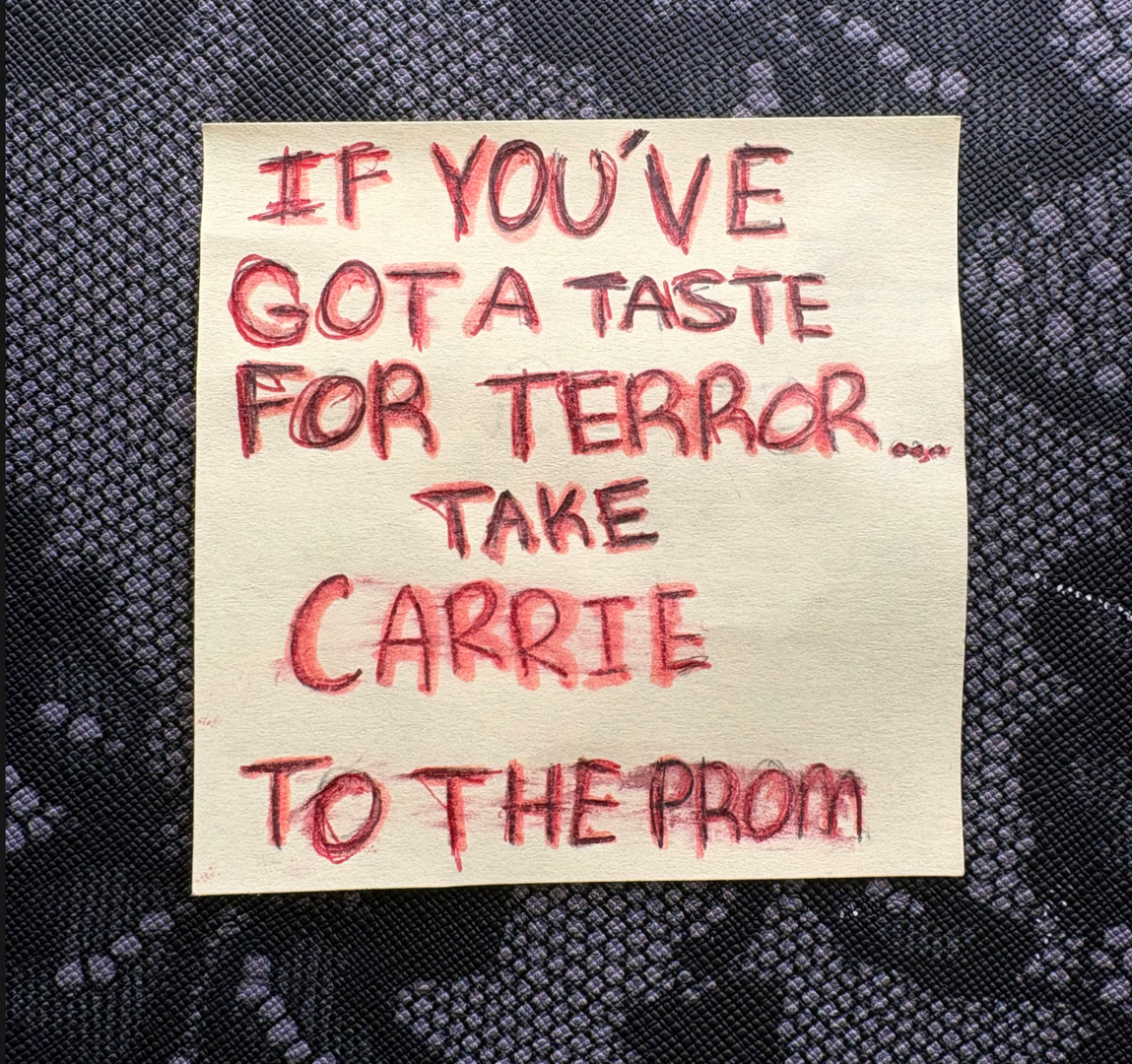
I started watching Mike Flanagan’s new Amazon Prime Carrie miniseries and made it through 30 minutes of the first episode before turning it off and rewatching HBO’s Sharp Objects for the umpteenth time (don’t worry, I finished it eventually). If the mention of Amazon Prime didn’t send shivers down your spine—don’t fret! The miniseries missed the mark in the horror department as well!
First off, I enjoy Mike Flanagan’s work (for the most part). Both The Haunting of Hill House and The Haunting of Bly Manor were evocative, memorable and, most importantly, horrifying reimaginings of Shirely Jackson’s and Henry James’ fiction, respectively. Did both series get screwed over by Netflix production? Absolutely. But this was the era where the streaming platform was more or less known for their twisted dramas. Netflix made it work; these shows were neither awful nor great, butcomfortable middle-ground to usher in horror audiences of the streaming age.
The new reimaging of Carrie is an entirely different beast, which disappoints and confuses me greatly. Flanagan has sunk his teeth into Stephen King’s work prior, with his adaptation of King’s 2013 novel Doctor Sleep into a horror/fantasy sequel to Stanley Kubrick’s The Shining. I thought Doctor Sleep was decent. Flanagan’s high concept direction mixed with King’s psychological horror beats made for an enjoyable watch. The kicker was this: I could tell it was an adaptation.
In my opinion as an avid watcher of things is that a great adaptation diverges from the source material in favor of convergence between relativity and a director’s streamlined perspective. The new Carrie reinvents the story as such: What if instead of the 1970s, it’s set in the age of the iPhone? And Carrie White is not so much a religious zealot and an outcast, but a perfect-victim, homeschooled kid with a questionably traumatic, but logical, relationship with her recently widowed mother, Margaret White? Instantly, the message of the story becomes skewed.
Brian De Palma’s 1976 adaptation of the book also suffers somewhat from the perfect-victim trope, but saves itself by portraying Carrie and her mother’s relationship as horrifyingly realistic and tragically believable. Margaret White’s reclusivity and hyper religious upbringing of Carrie builds a wall within the story that can never be breached. In short, Carrie can never get through to her mother person-to-person, ultimately isolating herself by victim of circumstance.
Flanagan’s Carrie portrays this mother-daughter relationship as codependent and somewhat reasonable. I don’t want to spoil anything major, but Flangana’s introduces a detective sideplot revolving around the mysterious death of Carrie’s father, Ralph White, which recontextualizes Carrie and Margaret’s situation as logically believable. The two characters don’t do much grieving beyond a few prayer scenes: no tears, then Carrie is shipped off to school and Margaret is forced to get a job to support her daughter. I’m not sure what to make of this change.
I think Flanagan’s ideas are interesting, but the execution of the final product just leaves me confused, asking the question: Was this reimagining really necessary?