
On the Fringe
Written by Sofia Welch
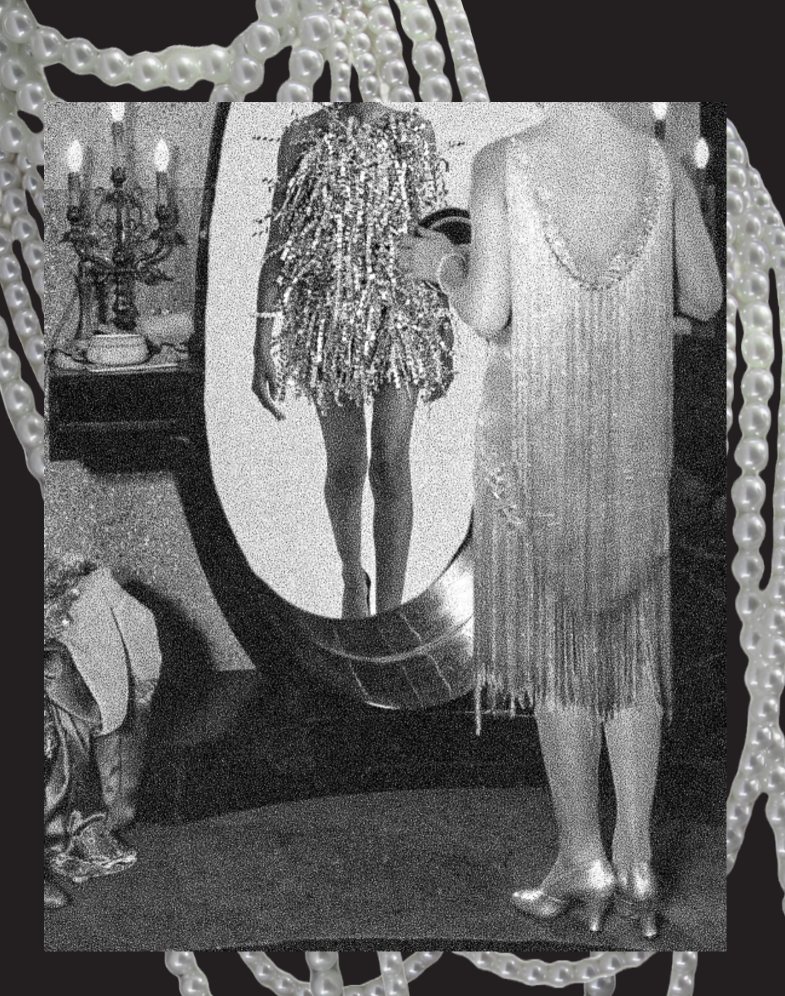
Art by Keira Mooar
In a dimly lit 1920s jazz bar, a flapper girl dances across the floor, the fringe trim of her drop-waist dress accentuating every move. Carefree, boundless, dazzling. On a runway during 2026 New York Fashion Week, a model crosses the catwalk in a voluminous, blue, metallic-fringe dress. Bold, sculptural, and commanding. It’s hard to tell where the fringe ends, and the girl begins.
I’m sure the first image that pops into many people’s heads when they hear “fringe” is the aforementioned “flapper girl.” In the post-WWI era, flapper girls moved away from societal norms of gender and fashion, tossing their corsets and long skirts aside for shorter hemlines, drop waists, and free-flowing fringe dresses that represented growing autonomy. During WWI, women took on many manufacturing and agricultural roles on the home front and played a larger role in society than ever before. This brought women from the fringes of society to the spotlight and fringe embellishment to those scandalously high hemlines.
Post-WWI, the 1920s became an era of excess and celebration. After tasting independence, women refused to return to the background. Fringe became a celebration of freedom, movement, and being seen. The fringe swayed wherever the body told it to. The eye-catching fringe made any woman hard to ignore. But just as the girls tasted the freedom and movement fringe could give them, the end of the decade brought the stock market crash and the beginning of the Great Depression. Women traded their fringe for aprons and work uniforms as they held down the home life and entered the workforce to keep their families afloat in an era of economic ruin and hardship.
But the fringe flame had been ignited. Its association with freedom would return in the 1960s with youth and the hippie movement. At festivals, teenagers danced in clouds of smoke with their fringe-lined suede vests and boots paired with bell bottoms. Hippies, passionate about the environment and fascinated by other cultures, found fashion inspiration in Native American clothing and its use of fringe. Across tribes, fringe can vary in placement, length, and decoration. Plains tribes like the Lakota wore longer fringes, while Southwest tribes like the Apache used shorter fringe with decorative elements like beading. Fringe served practical purposes in Native American culture, like helping leather and hide garments dry faster, but hippies were more occupied with fringe’s spiritual meaning. In many Native American tribes, fringe symbolized flowing energy, and its swaying in the wind connected them to the natural world, mimicking the movement of grasses and trees. This resonated deeply with hippies’ values: creativity, nature, self-expression. Many ideals of the hippie movement still resonate with young people today, including the fashion. Walk down Newbury Street, and you’ll see stores selling trendy fringed suede bags and tiered fringe boots. You can pass a stylish girl on the sidewalk with a fringe trimmed leather jacket, aptly dressed to get a matcha or see a set at Woodstock.
Fringe isn’t just on the sidewalk, it’s on the runway too. During New York Fashion Week, fashion label AREA recently revealed their Spring 2027 collection. When runway footage of the collection came across my feed, it stopped me in my tracks. I had never seen fringe like this. The video showed a wide range of fringe
iterations, from shimmering silver shreds to flowing strings of beads and shells. The collection represents fringe as far more diverse than historical examples. One look includes a fringed dress made of old jump ropes. Anything can be fringe. That is precisely the beauty of it. Fringe is an embellishment not dictated by material, but by form.
This return to fringe mirrors the desire for autonomy and expression seen in its use in the 1920s and 1960s. Amid vast sociopolitical upheaval and attacks on human art with the rise of artificial intelligence, a return to fringe offers creativity and freedom in response to a world that seeks to silence it. The versatility of
fringe represented in AREA’s collection exhibits the way modern imagination sees fringe as malleable, personal, and boundless. Fringe is no longer confined to movements or fabrics. Today’s fringe belongs to everyone. YM