
Are Butts The New Cleavage?
Are Butts The New Cleavage?
Written by Molly Peay
Art by Isabella Castello
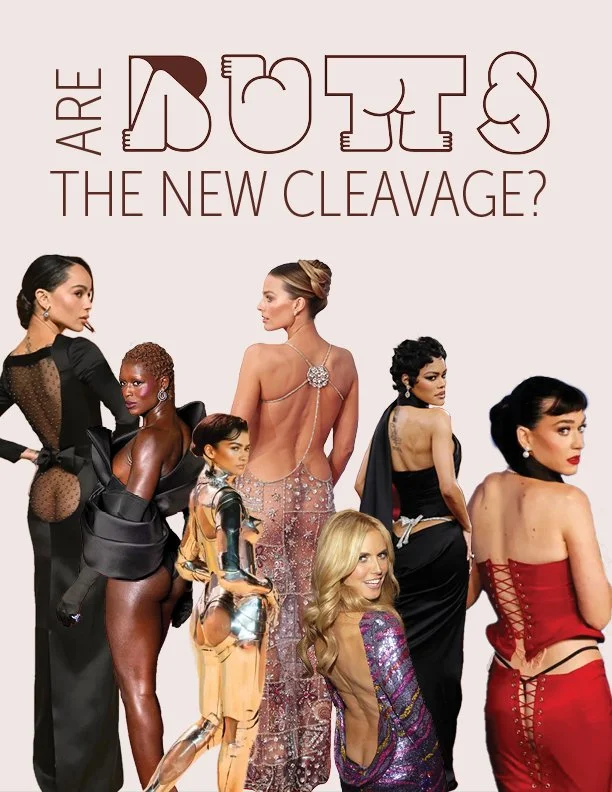
The butt is very much having its moment. Alexander McQueen’s 2026 Spring collection, Zoë Kravitz’s dress at the 2025 Vanity Fair Oscar Party, and Heated Rivalry all come to mind; Heated Rivalry fans have been posting edits of Connor Storrie’s and Hudson William’s shapely butts, and various articles have been published about how to achieve said shapely butt.
I’ll admit, I’ve been pulled into the frenzy. I want a Heated Rivalry ass. In the gym, I’ve steadily pulled out larger and larger weights, doing deeper and deeper squats. And, at the same time, I am ashamed that this body-trend has gotten to me; when body parts come in and out of fashion, the symbolic meanings attached to them are often forgotten or dismissed—and I did just that.
Historian Sander Gilman once said, “Buttocks have ever- changing symbolic value.” We associate the cheeks with motion, the hole with excretion, and the whole with sexual value. Yet, the symbolic meaning of the buttocks—much like how breasts are often tied to motherhood—are actually deeply connected to race, sexuality, and capitalism.
To understand that, let’s go back to the start: the story of Saartjie Baartman, or Sarah Baartman. Brought to London from South Africa in the early nineteenth century, Baartman was displayed for working and middle-class English people in a racist exhibition that promoted colonialism. She was exhibited for her “unusual” features, and was subject to inhumane treatment. The producers of her show used cartoon images of an African woman with a big butt as part of her exploitation; her “display” was used to construct a racial narrative framing black women as hypersexual.
After Baartman’s death, Georges Cuvier, a French scientist, conducted her autopsy. Cuvier believed white Europeans were at the top of the human hierarchy. Every other race was below. Heather Radke, author of Butts: A Backstory, states in an interview with W Magazine, that Cuvier claimed Baartman’s autopsy confirmed that “African women with big butts were more sexual than white women.” Though none of this is true, this supposed evidence was widely believed.
What’s important to note is that at the same time as these racist exhibitions were shown throughout England, bustles and corsets were all the rage. Both clothing items served the purpose of making the waist slimmer, and the wearer’s bottom fuller. White women could imitate curves without being defined by them.
In the present day, it is less common to wear corsets, and even less so to wear bustles. We do have, however, a more modern take: butt implants and rib remodeling. By getting a Brazilian butt lift and a few ribs removed, you can achieve the same effect that bustles and corsets gave nineteenth century white women: a slimmer waist and a fuller bottom.
When the trend shifts, as it inevitably does, both nineteenth century white women, and modern financially-able women are given a privilege to simply take it off. When the trend comes back into style: put it back on—whether a new piece of clothing, surgery, or workout plan. (Say goodbye to donkey kicks! Connor Storrie says elevated sumo squats are the secret to a bodacious booty. Though, how can anyone achieve such a round butt like an actor or influencer whose literal job is to look perfect.)
But, let’s take a step back for a second.
When Kim Kardashian was rumored (still never confirmed) to have removed her butt implants, the New York Post ran an article titled: “Bye-bye booty: Heroin chic is back.” But, as with the patriarchy, white feminine ideals, like heroin chic, never truly go out of style.
In Western society, light skin, thinness, and delicate features have historically been considered desirable and have allowed white women to exert authority within patriarchal systems; think Jane Eyre, the Victorian Era, and the Cult of True Womanhood. Professor Sabrina Strings, author of Fearing the Black Body, argues that colonialist ideologies believed “fatness was evidence of ‘savagery’ and racial inferiority” to white people; the white feminine ideal represents the benchmark woman—what women must achieve to be desirable.
However, the inherent racism in declaring what type of body is fashionable doesn’t mean we should swing the other way; it doesn’t solve the underlying problem. Often when a certain body type becomes acceptable (rather than trendy)—e.g. the butt—it still excludes people of color. The research article “Are We There Yet? Progress in Depicting Diverse Images of Beauty in Instagram’s Body Positivity Movement,” found that out of “almost 250 body positivity posts onInstagram…67% of the posts featured white women, with men and ethnic minority women seriously under-represented.”
So, even though the body positivity movement has claimed to celebrate diverse bodies, it centers white women. And the flip side—body trends like having a big butt—also does the same. A 2014 Vogue article titled “We’re Officially in the Era of the Big Booty,” focused on celebrities like Jennifer Lopez, Kim Kardashian, Miley Cyrus, and Iggy Azalea as the face of the butt trend. (When hip-hop and rap, aspects of Black culture, became mainstream in the 90s, it made butts trendy. So why weren’t any Black women featured in the article?)
Heather Radke suggests that many white women pursue having a big butt in the first place because it provides them “access to sexiness, an opportunity to rebel, (and) a way to push beyond the rigidity of white femininity”—that heroin chic.
At several of the Fall/Winter 2025 fashion shows, designers like Duran Lantink, Valentino, and Kiko Kostadinov exaggeratingly emphasized the models’ hips. These models were, of course, thin. Even SKIMS has opted into this, despite it being considered an inclusive brand. In 2023, SKIMS released Ultimate Hip. Clothes from the Ultimate Hip line were illusionary shapewear. They used soft pads embedded at the hip to create a full hourglass figure. But, if we have to change our body to fit into a trend, is it really inclusive? Is it really a rebellion to change our body? These fashion lines were just another way to opt into body trends, push the boundaries of white femininity, and also upkeep the moral standing of that “benchmark woman”.
And though the butt can function as a form of rebellion against the white feminine ideal, opting into wearing trendy features for only as long as it remains fashionable, does not truly work against the patriarchy. It only separates it from its history, sidelines the bodies of people of color, and ignores the shame that shaped feminine ideals in the first place.
Look, I am not here to tell you to stop shaking booty. The issue is not the butt itself. The issue is the way people, and particularly white women, treat the butt as something to wear when it is fashionable and discard when it is not. A butt is not a piece of clothing.
Real rebellion—or, simply, freedom—from the confines of white femininity comes not from chasing trends, but from accepting and appreciating every body, every butt, exactly as they are. Exercise for movement. And shake the butt your mother gave you—literally. YM