
A Meditation On Hinge
Written by Ella Donoghue
I know that their marketing team keeps pushing the idea that they are “The dating app designed to be deleted.” I know that even Zohran Mamdani met his wife on there. I know, I know, I know that it can be fun, and useful, and sometimes even produce something great. But what really keeps us coming back to Hinge time and time again?
We use Hinge to cure boredom; to fill a void; to wash out whatever bad taste the last sexual horror show left lingering; to forget; to find somebody who is random and disconnected and therefore easy to perform in front of or lie to; to fuck and never text again; to cheat. Rarely do I find that the typical intentions are as pure as the Hinge marketing team wants you to believe they are. If Tinder is The Father, then Hinge is The Son, and somehow, The Holy Spirit is entirely uninvolved.
Like your average social media platform, Hinge is contingent on—and profits from—our willingness to commodify our appearance and eagerness to advertise our sexuality. Instagram is the perfect platform for marketing ourselves and curating a self-indicative aesthetic; Snapchat has put to use all the right ingredients for optimizing casual communication and planning a rendez-vous; Tinder swiftly combined the sexual and romantic uses of the other two apps into one. Now suddenly—in the world of twenty-somethings, at least—Hinge seems to have become the one stop shop—the Amazon.com of sex. It’s users both the factory laborers and the products for sale.
But despite all my critiques, I still love you, my little Hinge Warriors. All the women who have no idea when their next boyfriend will come along, so they browse the app a few times a month, seeking casual sex partners in the interim. All the men who take a new date to the same restaurant every weekend until they find one they might actually want to take someplace better. The world-travelers who, like clockwork, ritualistically redownload the app in their Uber from the airport, assuming their promiscuous vacation-alter-ego, even if they never make time to meet anyone. And anybody genuinely in pursuit of finding somebody worth deleting the app for—I offer hopes and prayers: I hope that there are still some of you out there, and I pray that you find each other soon!
Hinge might seem like a homogenous place, especially if you have a “type.” Apps intended to produce social connections like to funnel people into reductive, oversimplified categories based on superficial specifications, such as “casual drinker,” or “not political,” so their algorithms can highlight more profiles that match the categories you fall into. Algorithmically sourcing partners creates the illusion of endless choice, but often narrows the options and reinforces patterns. Plus, compatibility is not decided simply based on how many Hinge prompt responses two people have in common. The typecasting done by Hinge may be efficient, but it’s entirely unreflective of the real, more diverse dating pool.
In reality, Hinge is a microcosm of the world: Vast and heterogenous and constantly evolving. Its best use, to me at least, is prompting some really deep and fulfilling conversations, some important sociological thought.
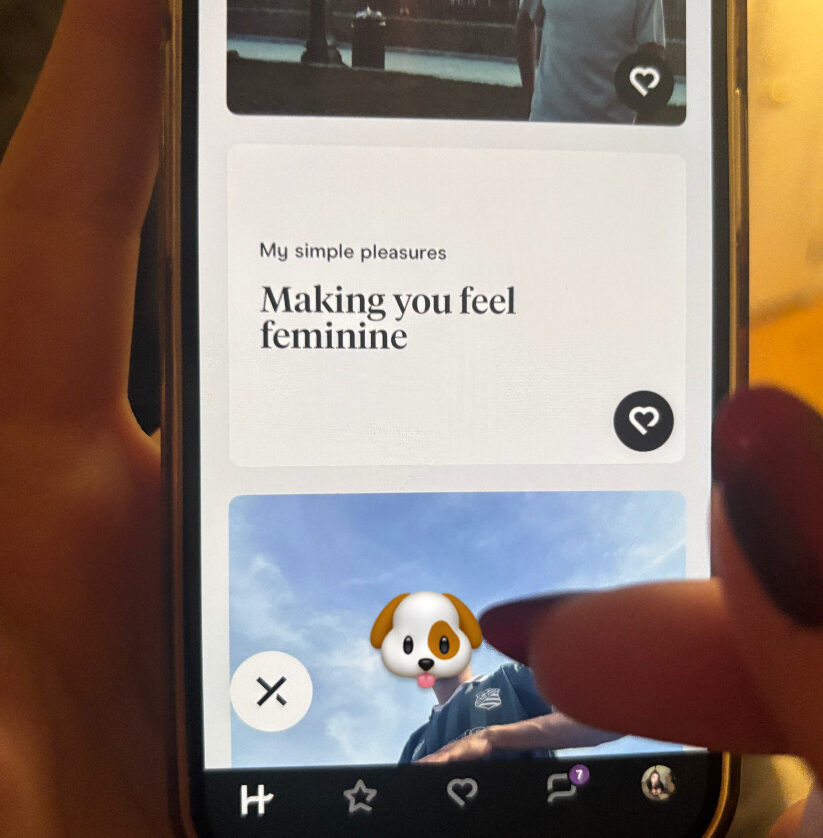
The Hinge profile is fascinating to me, especially since I’ve been in a relationship since March 2025. I’m the first to admit that I am not exactly hip to the dating scene, and that is by choice. I’ve seen some batshit stuff while looking over my roommate’s shoulder as she swipes through suitors:
I’ve seen multiple profiles of men with absolutely zero face photos (which is obviously an intentional choice by these users who may be dealing with some self-esteem issues) or zero relevant information in their bios, just a quick-to-the-point, “Trying to fuck tonight HMU.” She always declines these offers, but I can’t help but wonder if these tactics ever succeed.
I also like to ponder the thought process behind the selfies, the holding-a-fish pictures, the barely-clothed gym-mirror pics, and the classic picture-with-a-baby or picture-with-a-grandparent inclusions I see so often. What stories are we interested in telling to the ether filled with single strangers through the pictures we select?
And I am tickled most by the people that only go with group photos, so you can’t tell which is them. It’s always whoever is ugliest (sorry) but since we can always extrapolate that, why not just own it? Is there some secret benefit to advertising that you have friends with more visual appeal than yourself that I’m unable to comprehend?
And don’t get me started on the decision to include a voice note, which never fails to be off-putting. Or the prompt pandering that always says something like What can’t I live without: You!—you faceless, abstract concept of a woman who I have not met and do not know, but I hope I find at least somewhat attractive, otherwise I will not respond if you send me a like or a message.
Most of all, I love reading the overly-eager messages people send to my single friends. Step on me. You could murder my family and I’d say thank you. Let me worship you. They all attempt to find the most creative, yet alarming, unnecessarily freaked out, jaw-dropping way to say, Please have sex with me, please please please.
Hinge is probably the best sociological study on the digital behaviors of my generation that I could possibly imagine. Luckily, I don’t have to imagine—you people offer this entertainment to me free of charge! And it’s my favorite way to make fun of men. Hinge might not be the worst thing to happen to the twenty-something datingscape, but it is definitely the most thought-provoking, and by far the funniest. And I’ve Always Said That.