
Get In Loser, We’re Going To The Psych Ward!
Get In Loser, We’re Going To The Psych Ward!
Written by Kat Boscovic
Art by Isabella Castello
On Thanksgiving last year, I ended up in the psych ward. Not intentionally—though I’m not sure many purposefully seek out cutting up their food with only a spoon—but as a true New Englander, I needed my daily iced coffee, and my usual Dunkin’ was closed for the occasion. The map said my mobile pickup was a 10-minute walk near Tufts Medical Center. Half an hour of circling later, I found the Dunkin’ inside, wedged between the emergency room and the psych ward. Even the asylum runs on Dunkin’, I suppose.
I, who had only witnessed mental institutions on the other side of the fourth wall in film and television, expected something more obviously, well, mental: nurses in identical pastel uniforms distributing cups of unnamed pills, messy-haired women with cigarettes dangling from their lips, distant screams piercing through the buzz from the fluorescent lights overhead. But the hallway was indistinguishable from any other hospital ward; if I hadn’t read the sign at the entrance, I wouldn’t have pictured those wild-eyed women at all.
There seems to be a particular allure, a particular sexiness in the descent into insanity. Across social media, girls post photos and videos with the overlaying text reading, “i just need to be a victorian woman taken to the sea for hysteria”; “she’s a 10 but she would’ve been lobotomized in the 1950s”; “ready for my year of rest and relaxation (winter break)”; “every morning i choose between going to my classes or pulling a sylvia plath.” The letters are all lowercase, and the juxtaposed music, is more often than not, some song from Lana Del Rey’s Ultraviolence album, back when she would sleep with men twice her age and wasn’t just a normie—bonus point if there’s a pink ribbon looped into a neat bow.
We’ve built an entire trope around this character; the fragile girl with the institutional white gown fluttering like a nightdress from the breeze of a cracked open window where she smokes her cigarettes mid-breakdown. The appeal is not simply sadness, but containment—after all, femininity historically has always been a condition closely monitored and medically interpreted. As literary critic Elaine Showalter argues in The Female Malady, Western culture has long treated female emotion as something precariously close to pathology. The “madwoman” became one of the most recognizable figures in literature and culture as a volatile, fragile, and romantic character—but always ultimately confined.
This impulse to sort female behavior into recognizable narrative roles appears even in archetypal frameworks. In her 1984 book, Goddesses in Everywoman, Jungian analyst Jean Shinoda Bolen identifies seven female literary archetypes, with three teetering on the cusp of this madness in their own respects: the Mystique, the Lover, and the Huntress. When these archetypes slip beyond their prescribed boundaries—when desire becomes too attached, mystery too untethered, or independence too unruly—the narrative must find a way to contain them. Institutionalization, then, is not merely a medical response but a narrative one, a way of containing the excess of a woman’s character within the tidy architecture of the asylum.
And yet the modern internet seems less interested in the brutality of those institutions than in their atmosphere. Online, the asylum becomes some sort of retreat, a fantasy embedded in the relinquishing of responsibility by a regulated schedule and authority figure. In a culture where femininity increasingly resembles a form of constant self-management—tracking your moods, regulating your productivity, optimizing your mental health—the idea of simply collapsing into institutional care begins to feel perversely luxurious.
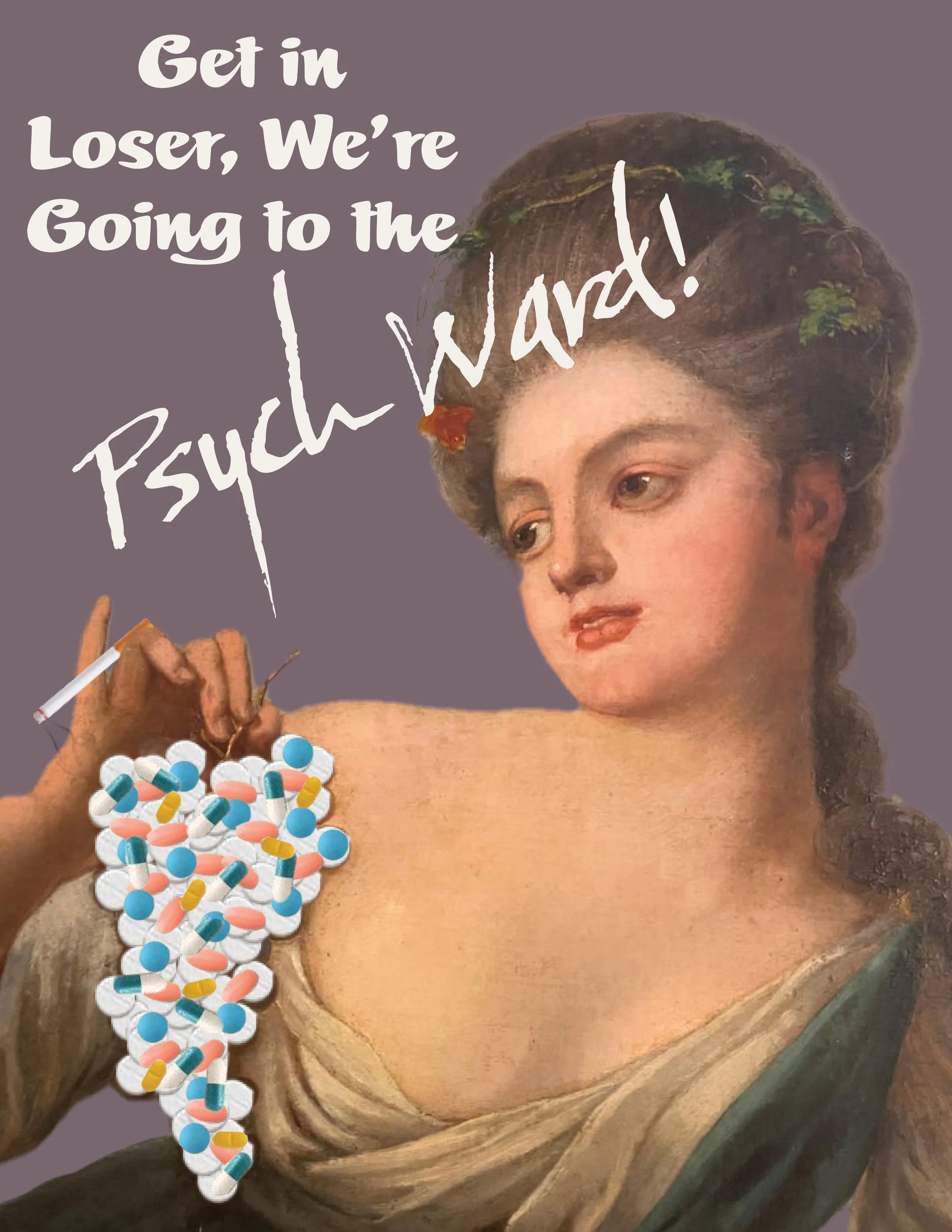
Even language reflects this shift, with girls joking about how they deserve a lobotomy for minor inconveniences and threatening sedation à la My Year of Rest and Relaxation. Though I believe the novel to be one of Ottessa Moshfegh’s lesser works—criminal, I know—it remains an undeniably poignant tale of self-sedation to opt out of the endless administrative labor of womanhood. Yet, the book has been reinterpreted as an aspirational text, even the jacket cover participating in the misreading. Portrait of a Young Woman in White, once a depiction of aristocratic apathy in the aftermath of the French Revolution, adopts a new context when wrapped around Moshfegh’s novel. The image she writes of is no longer a story of a cruel, drug-addled, or grotesque narrator, but a languid anti-heroine, a beautiful girl too bored with the world to participate in it. Pharmaceutical hibernation begins to resemble the modern equivalent of that same aristocratic ennui, and unsurprisingly, the public perception faced no distressing dilemma in choosing which reading to receive: the seductive possibility of disappearing for a while under medical supervision provided by a friend who checks up on you every week or so, and the occasional pizza to keep you alive. How else is a girl going to sedate herself without Quaaludes nowadays?
This reinterpretation fits neatly into a longer lineage of romanticized female collapse, whose mother novel is none other than The Bell Jar. Published in 1963 only a month before Sylvia Plath’s own death, the novel has since become a canonical text of feminine breakdown. Protagonist Esther Greenwood’s descent from being a guest editor at a glossy Manhattan magazine to enduring vomit-inducing electroshock therapy and a failed suicide attempt is nowhere near glamorous, yet the bell jar itself—Plath’s metaphor for the sealed atmosphere of depression—becomes decorative, a glass dome trapping a beautiful sadness inside it. If Pinterest were any indicator of culture, it seems now that everyone and their mother has a purple fig tattooed on their body—another metaphor that was originally intended to communicate suffocation. And so the same woman who wrote “Is there no way out of the mind?”, who wrote, “If I didn’t think, I’d be much happier,” who wrote, “It is so much safer not to feel, not to let the world touch me,” and who killed herself via head in the oven, becomes an objective on a vision board.
Cinema, of course, wastes little time translating this aesthetic into images. If the literary madwoman drifts beneath a glass bell jar, the cinematic one wanders the corridors of the asylum in slow motion, cigarette smoke curling toward fluorescent lights. Few films have done more to cement this image than Girl, Interrupted, adapted from Susanna Kaysen’s memoir of her 18-month stay in a psychiatric hospital in the late 1960s.
“Maybe I was just crazy,” Susanna, the protagonist, reflects in the opening narration. “Maybe it was the sixties. Or maybe I was a girl.” The line gestures toward the same historical tension that critics like Showalter have traced for decades, that uneasy overlap between female emotion and psychiatric diagnosis, but the Girl, Interrupted adaptation adds to the narrative magnetism. If Dead Poets Society gave us the romantic mythology of the troubled boy in the classroom, Girl, Interrupted feminizes that mythology by relocating it to the psychiatric ward. The desks and chalkboards may be swapped for hospital beds and group therapy circles, but the structure is familiar: a cohort of young people bound together by crisis, each with their own dramatic pathology. Much of it gathers around Lisa Rowe, the sociopathic ringleader played with feral allure by Angelina Jolie, whose instability becomes a spectacle—dangerous, no doubt, but thrilling to the voyeur.
Recently, an audio clip has surfaced on TikTok from the film, an exchange between Susanna and Dr. Crumble that occurs in the first 10 minutes: “Susanna, four days ago you chased a bottle of aspirin with a bottle of vodka.” To which Susanna casually replies, “I had a headache.”
Girls with wide eyes and pouty lips lip-sync the audio beneath overlaying captions about their most recent mental breakdowns: sobbing on the bathroom floor, throwing a hairbrush at the wall, or disappearing into days-long episodes of self-isolation. The performances are exaggerated but strangely sincere, delivered directly into the front-facing camera like miniature monologues.
The result is a peculiar loop. Culture produces the archetype of the unstable girl; film refines it into a compelling narrative with aesthetic shots; the internet then redistributes the fragments back to its users, who rehearse the role themselves. The unstable girl is no longer a patient, but a character waiting to be inhabited. Perhaps this is the only logical endpoint for a society that already treats femininity as a self-managed clinic where the body is already governed by a scrutinizing gaze. In her song, “Ride,” Lana Del Rey says, “I am fucking crazy/ but I am free.” Sure, you may be fucking crazy, but are you truly free if your madness is less concerning than it is beautiful?
You’re certainly not free from the male gaze. Enter the male spectator, those boys who claim online that they like “crazy girls” and “evil women.” Because I believe Hinge’s purpose to be one of rage- baiting and pranking men—sue me—I once matched with a man whose profile proudly declared his attraction for these “unhinged” ladies. At one point in the conversation, he told me—completely earnestly—that he would feed me my antidepressants “like grapes.” So the languid patient is draped across the fainting couch, the attentive man hovering over her with a bottle of pills, dispensing them one by one into her mouth like a Roman emperor. Her chaos is contained by a man who can administer the cure, and that is her sex appeal.
Obviously, I never met up with this Hinge “prospect”—though a genuine prospect he was not. If I were truly crazy, I doubt a mere man on a dating app—5-foot-7, at that—would be the antidote to bring me back to sanity. Nor would this craziness be glamorous in the slightest; when I finally found that Dunkin’ at Tufts Medical Center on Thanksgiving, there were no cigarettes propped on the ledges of cracked open windows or languid anti-heroines drifting through the hallways like they had wandered off the set of Girl, Interrupted. If anything, the most remarkable thing about the ward was how ordinary it felt. No one was feeding anyone antidepressants like grapes, yet the fantasy persists of a character waiting to be inhabited, rehearsed, and circulated again. Meanwhile, somewhere between the emergency room and the psych ward, Dunkin’ keeps serving iced coffee.