
Authenticity of Youth: A Lost Art
Authenticity of Youth: A Lost Art
Written by Madelyn Mchoul
Art by Emma Fisher
It’s a Saturday night, and there’s a cold sweat dripping down your neck. You notice the way it glistens against your skin, highlighted by the intense lighting of the room. Music is blasting, and the lyrics move along with every movement of your body perfectly—you feel unstoppable.
Catching a glimpse of your reflection, you notice how the sweat has infiltrated your hair, and your leg muscles are shaking at an impossible pace. Allowing yourself to sink into the final beat of this moment, everything else around you fades into nothingness.
Finally, your body stops moving, and you’re forced to tear yourself out of this once marvelous moment. Stolen by the never-ending passing of time, you can never seem to hold onto the present. Tearing your headphones off, you let out a groan that echoes throughout the entire gym; reality has caught up to you.
A myriad of self-criticisms consume you. I could have gone for longer. I could have used a heavier weight. I could have tried a different, harder, better method. Reaching for your phone in your pocket, its weight surprises you, feeling heavier than the 75-pound weights you were squatting with. You open TikTok, immediately going for advice from the first influencer that appears in your search, all while a dozen gym-goers exist around you. Ignoring them, you try not to care about their prying eyes.
The thought of those eyes even wandering towards your isolated corner of the gym terrifies you, and you continue your attempt to hide yourself inside your phone. All the advice you could ever need exists inside there anyway, and it takes away the embarrassment of being perceived as dumb or even weak.
It hadn’t always been this way; the pressure, the isolation, the insecurities. There had been a time when young people could simply exist, but an existence like that seems so foreign to you.
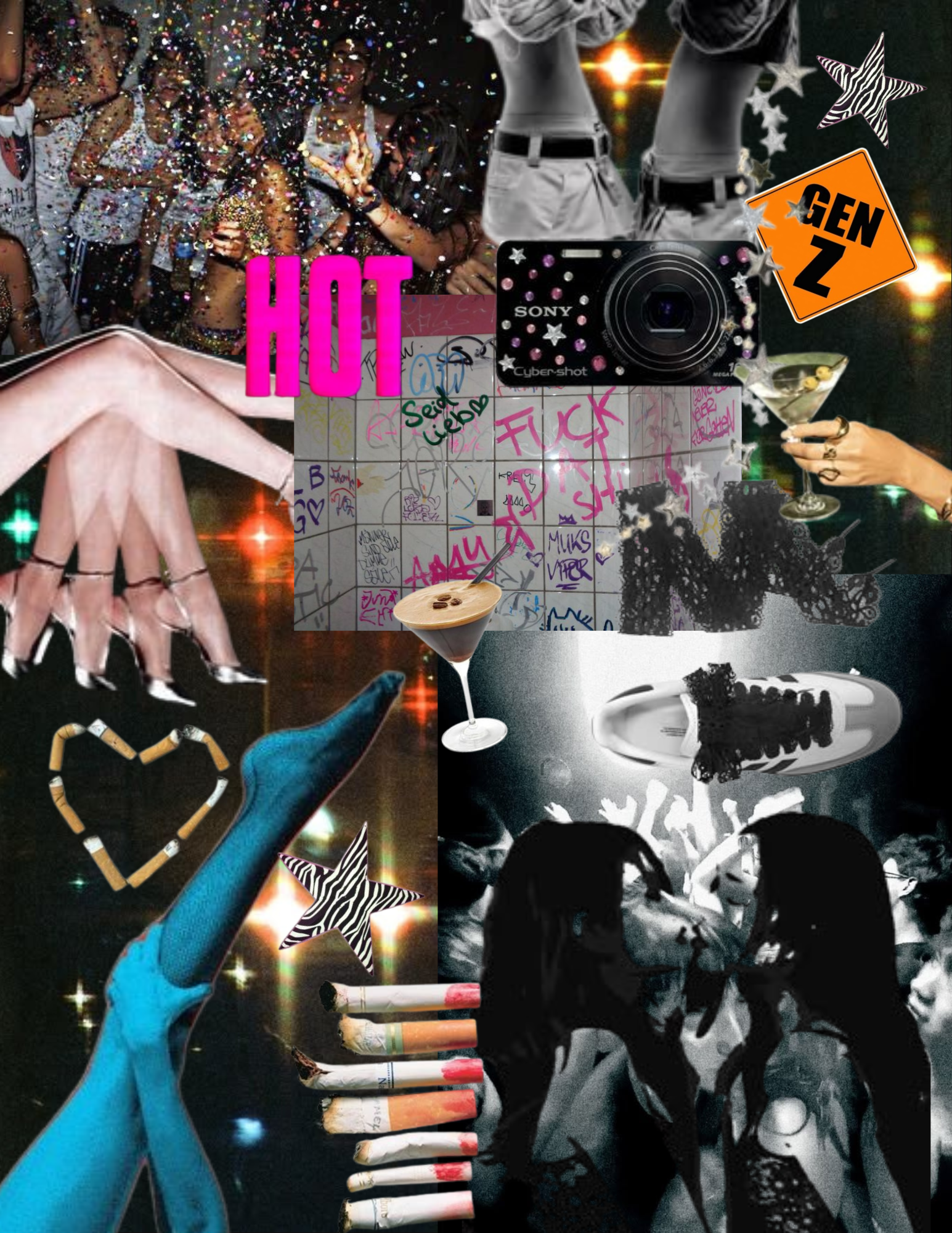
You remember the stories your mother told you of her youth, stories of late-night club adventures and dangerous drinking escapades. You think of the late ‘90s and early 2000s films you binged in your childhood, the ones that promised a coming of age that consisted of dancing nights and strobe lights that had the potential to turn one blind.
But those times have come and gone, just like everything else in history. Your grandmother strutted under fluorescent colors with hair too wild to tame in the age of discos. Your older sister danced with strange men in strappy heels, a $4 drink in her hand, and completely roused by the potential of the upcoming millennium of the 2000s.
And you? You’re at the gym, nothing to look forward to except for a meal preparation of rice and ground beef, and an eventual late-night decompression, lost in a world of Instagram reels and Pinterest boards.
While you desire the freedom and ambiguity that comes with a night out, you can’t help but think of how much it would haunt you afterwards. There’s a fear that exists within you, a fear of being negatively perceived. The thought of someone even catching a glimpse of you in such an embarrassing state, or noticing how the drinks you’ve consumed have caused a slight puff in your cheeks, sends you and almost every young person you know into a state of paralysis. The anxiety of having to fulfill the life portrayed on social media only heightens this experience. While this fear has always existed, your generation is undergoing a new version of it.
You close TikTok, taking a quick look around the gym—you had almost forgotten you were there—after getting lost in the motion of thumb scrolls and the dopamine-boosting content. Across from you a young woman, close to you in age, is making intense eye contact with herself in the mirror as she moves around with a dumbbell. A little bit away from her is a teenage boy, taking pictures of himself that will surely be uploaded to a Snapchat story in the next few minutes. On the other side of the gym, you see a charming young man chest-pressing three times your body weight; you make a quick mental note on how he is just your type, but you know you’ll never approach him, and he’ll never approach you.
You observe these individuals, these faces that you will never know the names of, or the stories that come with them. You can’t help but reminisce on a past you were never a part of, wondering if, in a different place, at a different time, this could all be so different.
Not even 10 years ago, young adults were still so tightly bonded over the power that youth holds: the ability to forget the anxieties of the future, indulging themselves in a certain gratification that only exists when you’re young, and possessing the ability to simply live in the present. They expressed this power for decades, embracing club and party culture, making lifelong friendships, and discovering authentic, well-fit communities in the process.
Then, it was your generation’s turn to embrace this lifestyle, and suddenly, the entire world seemed to shift in a different direction.
In an instant, the comfort of self-isolation and dependency on technology introduced a new priority to the youth, a dangerous priority: individualism. The days of living out your youth have simply faded into the memories of older generations.
The communities and relationships that had been fostered by the previous youth culture almost seem unachievable in the new world of wellness culture and independence. You’ve been forced into an artificial reality where almost everyone’s behavior is dictated by a glowing screen; you feel helpless, and so alone.
You take one more glance at the cute chest-presser across the gym, a sliver of hope lingering within you. Then, the moment passes, and you slide your headphones back over your ears and reach for the weight once more. You accept your reality and begin to forget the authenticity of youth that is stuck in the past.