
Debby Harry, Punk Pinup
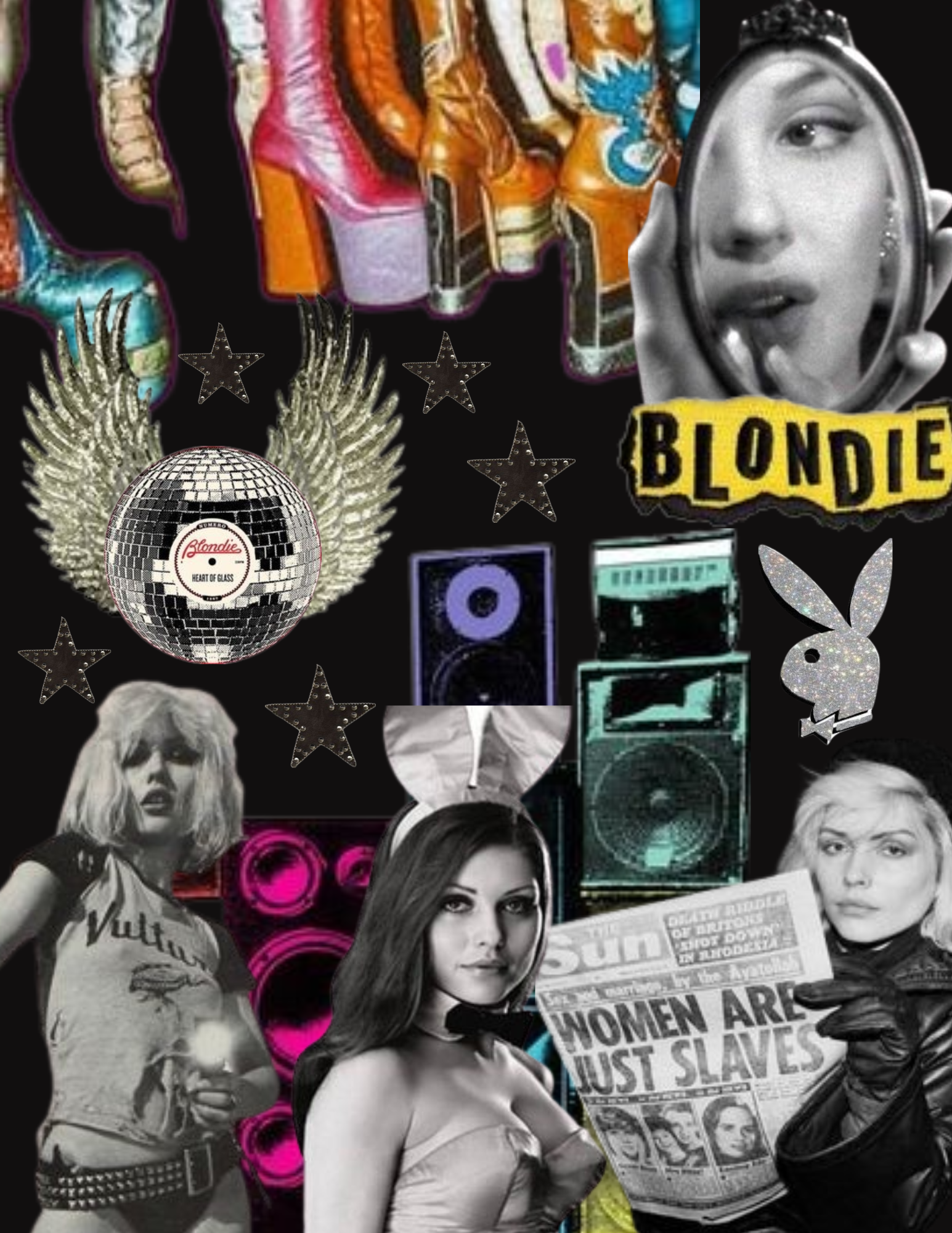
Debby Harry, Punk Pinup
Written by Heather Thorn
Art by Emma Fisher
Before rising to fame as a rock and roll sex symbol known for her platinum blonde hair, Debbie Harry, frontwoman of Blondie, was a brunette bunny. Commuting in from New Jersey, Harry worked as a Playboy Bunny at the New York Playboy club in the late 1960s—a job less glamorous than Hugh Hefner would’ve liked to admit.
“Being a bunny was not at all like what you might think,” Harry wrote in her 2019 memoir Face It. Wearing a corset, collar, bunny ears, and tail while waitressing was no easy feat, especially when most of the customers were businessmen in expensive suits. The job was hard work but allowed Harry to independently support herself while pursuing a music career; she also learned first-hand how to build a presence when performing.
Harry would rise to rockstar status six years later after forming the band Blondie. Backed by drummer Clem Burke, bassist Gary “Valentine” Lachman, Jimmy Destri on keys, and Chris Stein on guitar, Harry was the lead singer of Blondie. The group got its start playing at CBGB’s, a gritty music venue in Lower Manhattan, in the late ‘70s. Along with Talking Heads, Ramones, Television, and Patti Smith, Blondie defined the punk rock scene at CBGB’s, becoming one of the most commercially successful artists to emerge from the venue; Harry instantly became an icon as the face of Blondie. A rock icon, a punk icon, a style icon, and yes, a sex icon.
Just like how the band blended punk, disco, and new wave genres, Harry blended different styles to create a seemingly contradictory image: the blonde bombshell with a punk persona. Her shaggy platinum blonde hair made her instantly recognizable, along with her full red lips, petite frame, and striking looks. Andy Warhol once said that if he could have anyone’s face, it would be Debbie Harry’s.
Blondie’s third studio album, Parallel Lines (1978), propelled the group into global success with its star-studded tracklist that includes “Heart of Glass,” “One Way or Another,” and “Hanging On the Telephone.” With Blondie’s international acclaim came fans and press who paid sole attention to Harry. Eyes lay only on her: onstage, on posters, and on screen. The media focused so heavily on Harry that many people made—and make—the mistake of thinking that Blondie is only one person, leading to their 1979 campaign with buttons that said, “Blondie is a group!”
In addition to writing, recording, and performing music, Harry posed as a punk pinup for photoshoots in rock magazines CREEM and Punk. “I liked that I was on the fans’ bedroom walls, helping them to entertain themselves,” she wrote in Face It. “You could say that I was selling an illusion of myself. But the biggest seller is always sex.”
The media would go on to describe Harry as a “sex symbol,” reducing her artistry to her beauty in an attempt to commodify her sexual image. But the sexual attention Harry had received her whole life also happened to be Blondie’s namesake; when she dyed her hair platinum blonde in the mid-70s, construction workers and truck drivers would call after her, “Hey, Blondie!” Soon, the word followed her everywhere she went and just stuck.
Naming the band Blondie was Harry’s way of reclaiming her objectification while also creating a persona. The other part of the band name’s inspiration derives from a famous comic strip in the ‘30s called Blondie. It follows a blonde flapper called Blondie Boopadoop who marries a wealthy playboy, but don’t underestimate her—she ends up being smarter than the rest of her brigade.
Embodying the Blondie character onstage, Harry became a cartoon fantasy with sex appeal—a persona that included femininity, naivety, and a punk attitude. “I have always thought the contrast between innocence and lusty sexuality, like that between good and evil, is irresistible,” she wrote in her memoir.
But the true inspiration behind the Blondie character was Marilyn Monroe. Monroe soared to starlet status in Hollywood first as an actress and then as a sex icon. Her hourglass figure, full lips, sultry gaze, and breathy voice captivated audiences, and Hollywood began typecasting her as a blonde bombshell in movies such as Gentlemen Prefer Blondes (1953), How to Marry a Millionaire (1953), and Some Like It Hot (1959). She played oblivious, overtly sexual characters; eventually, her image as an actress became inseparable from the “dumb blonde” act. Too busy appreciating her looks, the public had failed to acknowledge her talent.
Yet even at a young age, Harry identified with Monroe’s femininity and how she carried herself on screen, oozing sexuality. “From the first time I set eyes on Marilyn, I thought she was just wonderful,” Harry wrote in Face It. “I loved the fantasy of it.”
At the same time, Harry noticed the dual sides of sexuality even in childhood. Sexual energy was repressed, and the expectation for girls was to remain a virgin until they got married, settled down in the suburbs, and had children.
“The fact that she was such a hot number meant that many middle-class women looked down on her as a slut,” Harry wrote of Monroe in her memoir. “I felt that Marilyn was also playing a character, the proverbial dumb blonde with the little-girl voice and big-girl body, and that there was a lot of smarts behind the act.”
Monroe’s “dumb blonde” persona strategically created an image that appealed to Hollywood’s expectations of a woman both incompetent and sexual—and as a result, sold well. Her high-pitched voice played into a “childlike” vulnerability that viewers could both sexualize and perceive as non-threatening. By crafting an appearance that was more innocent and less intelligent, Monroe skyrocketed in popularity and profited from being underestimated.
The “dumb blonde” and “blonde bombshell” tropes have been around for centuries, tracing back to the 1800s with women being stereotyped as having perceived innocence, sexual availability, and dim-wittedness—and blonde hair.
“I never felt that way about her,” wrote Harry in Face It. “My character in Blondie was partly a visual homage to Marilyn, and partly a statement about the good old double standard.”
The music scene out of which Harry emerged was dominated by male rock stars whose sexuality was celebrated while women’s was punished. As frontwoman of Blondie, Harry defied the male- dominated rock scene of the ‘70s by embracing her femininity and sexuality—asserting her style, confidence, and vocals to both catch men’s attention and unsettle them.
“Sex is what makes everything happen,” Harry wrote in her memoir. “In the entertainment field, sex appeal, looks, and talent are the primary factors.”