
Consumer
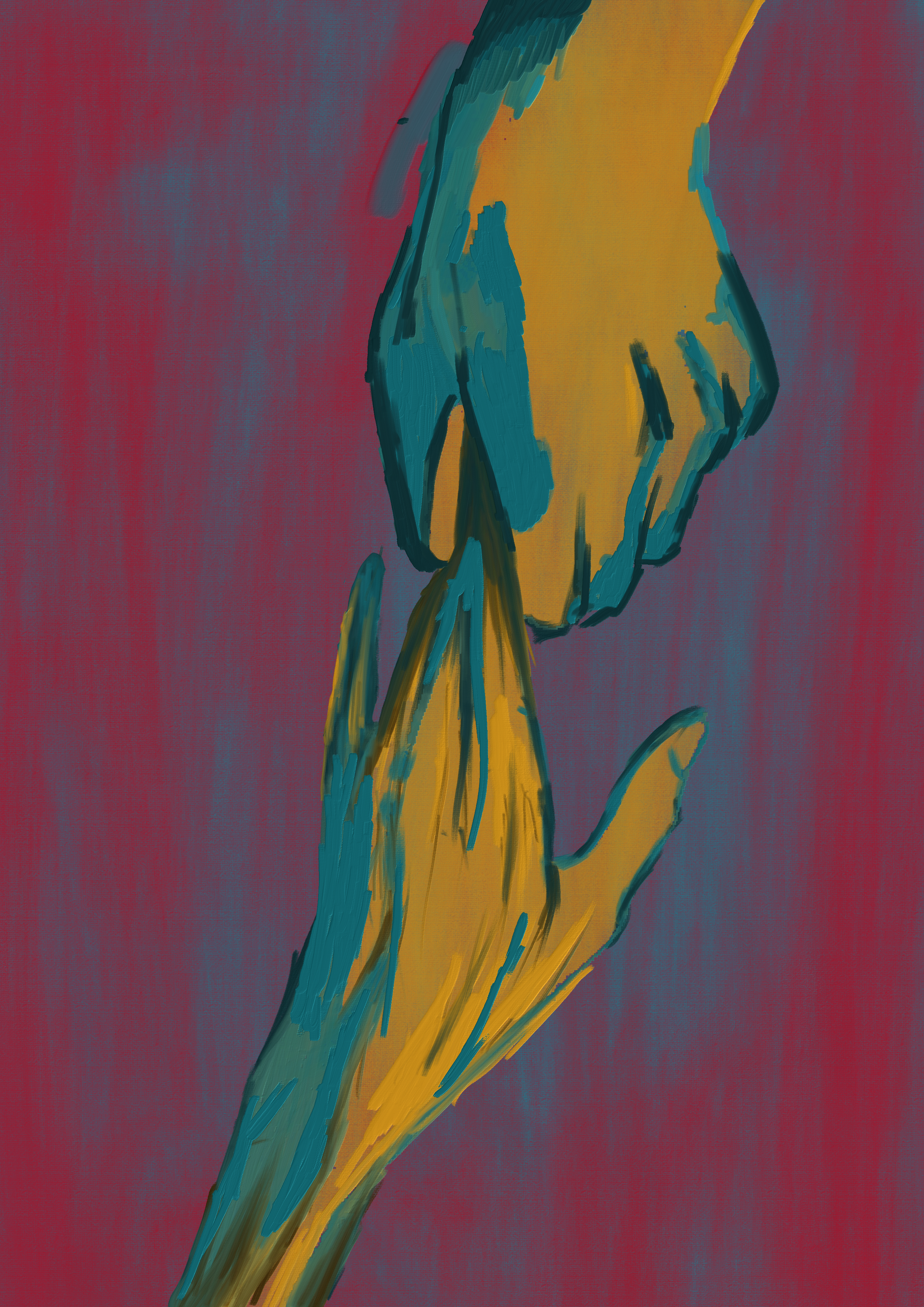
Consumer
Written by Ella Bower
Art by Izzy Maher
On one of the very few dates I went on, the guy I was seeing looked at my breasts and called them “little hamburgers” (I’m at least a Jr. Whopper!) He then later grabbed my stomach, jiggled it, and called it “cute”—one of the worst things someone can do to a chubby girl like me.
I think long and often about why I can’t leave bad dates, why I feel compelled to see things through to their hapless ends. Perhaps it is because my parents met on a dating site and I grew up hearing endless stories about how they “never would have met organically—It was meant to be.” But when I downloaded Hinge, I wasn’t looking for a life partner or sex; I wanted to verify I was a catch. I received some likes, some boring text exchanges, but when I ultimately ghosted someone, being (rightfully) unmatched still hurt.
That’s the trap. Dating sites like Hinge are built to keep validation seekers on a loop. Hardly anyone ever really leaves. We always come back when we feel lonely enough, when we want to exorcise the ghosts of relationships past. We use the app not just for conversation, but also in the hope that we’re noticed for our meticulously crafted prompt responses and our carefully curated photos.
On my own profile, I am funny and smart in my responses and my photos are conservative, except one—my most liked photo, often making me question the likers’ intentions. Then I remind myself about my own intentions for being on Hinge.
There’s a screening process I have: ‘Short term-open to long’ means they want to hook up. ‘Short-term relationship’ means they want to hook up. ‘Life partner’ will not say no to a hookup. Don’t even get me started on ‘not political’ or ‘moderate.’ Beggars can, in fact, be choosers.
But even when I weed people out, the emotional dip of the validation loop is unavoidable. Women I know and I have all received the “You’re ugly anyway” message from men we’ve rejected. We go from feeling like a ten to a solid five, regardless of whether they are strangers on the internet or not. Still, each and every one of us continues to participate in the dating app’s validation economy: we send pictures of ourselves sucking in our stomachs, and make half- hearted compliments, expecting something in return. And it collapses every time we lie to someone’s face, hoping they’ll return a compliment. Being rejected by dozens of consumers every day banks on our need to be liked.
Meanwhile, because of my unpassable test of political affiliations and openness to meaningful relationships, I never actually planned on meeting most of my matches. At some point, though, my need to be seen as an honest woman and the pressure from modern dating culture becomes impossible to avoid, like in the case of Hamburger Guy.
I spiraled after receiving his text that our first date was “a little dry,” even though I wasn’t that into him. I wasn’t even planning on seeing him again. Was I boring? No, I’m not. So why did it hurt so much coming from the guy I intended to ghost?
Despite my better judgment, I went on another date with him. He actually showed a bit of personality, which he needed to make up for his lack of good looks. He was proud of his home country and liked sea lions, which I thought was endearing. However, the entire date I was thinking about how I had put on makeup and he was in an old t-shirt. I was trying to convince myself I’m not that superficial.
When he invited me to watch a movie at his apartment for a third date, I felt I had to agree; if I said no, I felt like I would be a liar. I even said I liked him, though I actually didn’t. I just wanted to prove I was as good as my word.
I, and almost every other person in the dating game, know that when you go watch a movie with someone at their house, there won’t be any actual movie watching. But I wasn’t there for kanoodling, I was there to prove I was an interesting, non-superficial, and totally independent woman who didn’t need a man. That fear that I wasn’t all those things already kept me seated—cornered—in that apartment in Cambridge.
In reality, if I had been truly self-confident, I could have walked away without staging an emergency phone call from my friend. Afterwards, I realized I shouldn’t market myself to strangers on the internet when it costs me my self-respect. We all deserve to get what we want out of relationships without spending our dignity in exchange for a little validation.