
Autism is… Hot Now?
Written by Kylie Lohse
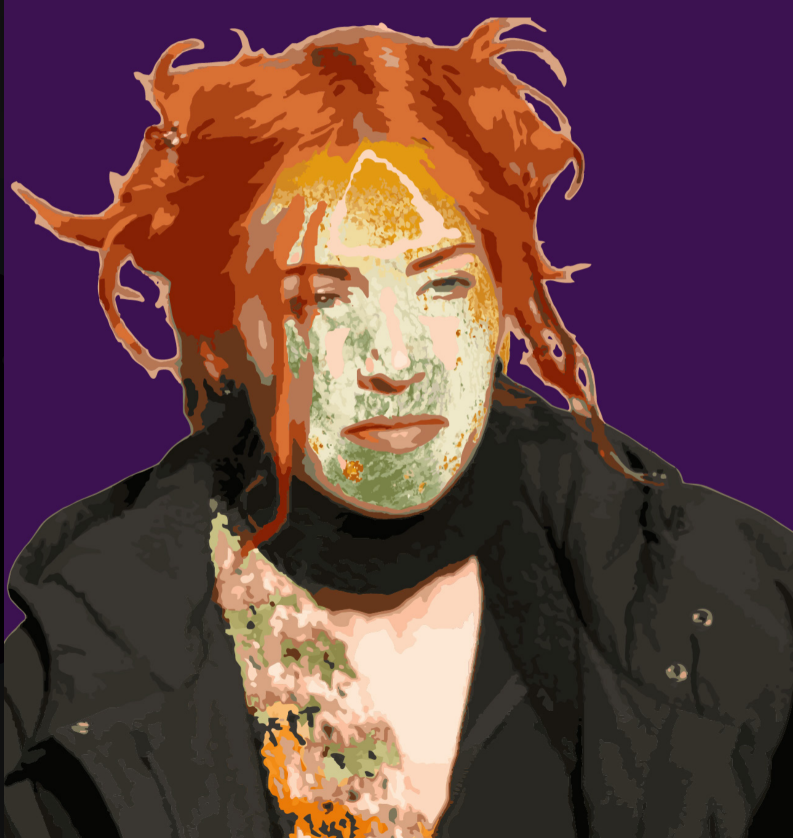
Art by Keira Mooar
I realized that my brain made me ugly when I was 12.
It was the day before school picture day in 7th grade, a little over a year after I found out about my autism diagnosis. My home-room teacher was going over the general dress code, reminding us our outfits should be school appropriate.
“I’m going to dress autistic tomorrow,” my classmate whispered into my ear.
“What do you mean?” I asked, playing dumb. He didn’t know that I was autistic. No one knew, then.
“I’m going to dress ugly,” he said, expecting me to laugh along. But I just stayed quiet.
I browsed the internet, researching the part of me I was trying my best to conceal. Google told me autistic people are “socially awkward” and have trouble maintaining romantic and platonic relationships. I browsed images of what autism “looked like,” and found a plethora of photos of conventionally unattractive white boys with acne and greasy hair.
The worst thing for an already insecure adolescent girl to find out is that her condition is deemed ugly by society. I had been told that I was pretty before, but now I wondered if that was true. I thought telling someone that I was autistic would soil their perception of my physical appearance, that this one simple fact about my psyche was what deemed me worthy or not.
Sometimes, the opposite would happen. I informed people of my neurodivergence and was told, “You don’t look autistic.” What I heard: “You’re too conventionally attractive to be autistic.”
That was my answer. I would be ugly and unlovable for the rest of my life. I would never discover what it was like to be loved by someone, for someone to want to spend the rest of their life beside me. Since you have to be nice to the autistic girl, I felt that no one would ever truly find me attractive outside of pity.
But then one day, once I was no longer an awkward preteen and instead an adult woman in college, it seemed that my diagnosis was no longer a hindrance to my “attractiveness,” but a benefit. It was as if someone simply flipped a light switch, turning autism hot.
I discovered a new trend on TikTok where women filmed their boyfriends and their unique interests or slightly quirky habits. The audio accompanying the video said, “I like him. I like that autistic man, and would I be wrong if I asked him at dinner, ‘Is you autistic, cause I like that.’”
There was also an upsurge of people, mostly men, talking about how they wanted their girlfriend to be “a little autistic.” Women proudly called themselves “neurospicy,” a slang term used to describe neurodivergence. I knew the internet tended to be sporadic and change its opinions in a blink, but I wasn’t expecting to go from videos mocking “the autistic kid in class” to videos captioned, “I want an autistic girlfriend, tbh” just a few scrolls away.
The emerging desire for an autistic girlfriend felt vaguely familiar at first; then, I realized this trend has happened before with he Manic Pixie Dream Girl (MPDG) film trope. The MPDG is an eccentric, quirky young woman who exists solely to further the male love interest’s character arc. But I noticed a lot of the traits of the MPDG are traits common in autistic women. The MPDG trope portrays autistic women as objects to be fetishized and used by men, rather than treated as an equal partner in a relationship.
I started to wonder what it would be like to be in a relationship with someone fascinated by this fantasy. I don’t want to be someone’s Alaska Young or Ramona Flowers, reduced to bringing my innocent quirkiness into their life. Would they leave me once they realized that autism isn’t a character trait, but a disability that
affects almost every aspect of my life? I imagined this person falling in love with their assumed perception of me created by the media, and eventually discovering the non-fetishized side of autism. Would they bite into me thinking I’m a ripe Clementine only to realize that I’m rotten on the inside?
My fear of being rotten on the inside doesn’t just apply to romantic relationships; I’ve felt this way in many platonic friendships. I’d enter a friendship with a very filtered version of myself, masking the unattractive parts. The mental breakdowns, the special interests, the awkwardness and lack of social cues—all of that hides under a thick layer. I’d eventually reveal to them that I’m autistic once this mask was exhausted and I felt I could consider this person a true friend. They’d typically accept me initially; “That doesn’t change anything, you’re still my friend.”
But then we’d both slowly realize it wasn’t true. I’d mask myself less, revealing more of myself, the rotten parts. And then I’d finally expire and lose a friend.
Seeing autism suddenly portrayed in this fetishized and romanticized way has caused a roller coaster of emotions in my brain. At first, part of me was happy that I was finally considered attractive by mainstream society. But as I thought about it more, only certain parts of autism were deemed attractive, and I fell back into my melancholic state of feeling unlovable and fixating on my physical appearance in order to compensate for something.
What I realized about love is that it can’t be forced. You can’t force yourself to love or to be loved by someone who won’t accept you for who you are, who won’t embrace both the ripe and the rotten parts. I can’t force myself to be someone the world wants me to be in order to experience love.
So I tell myself that I will find my person one day, someone who wants to chew on a rotten apple. Someone willing to love meunconditionally for who I am. YM